
If you’ve been in the plumbing business for a while, you’ve probably said this out loud more than once:
“Why the hell are leads so damn expensive?”
Whether you’re buying leads from Angi, running Google Ads, investing in SEO, using Local Services Ads, or testing Facebook and Instagram, it can feel like you’re paying more every month just to keep the phones ringing.
And even when the leads come in, it doesn’t always feel like the business is moving forward.
You spend more. The agency reports more calls. Your technicians still have holes in the schedule. At the end of the month, you’re left wondering where the money went.
Here’s the truth:
Plumbing leads are expensive right now. But they aren’t always expensive for the reasons you think.
In many cases, the bigger problem is that owners are measuring the wrong number.
Cost Per Lead Is Not the Number That Pays Your Bills
The biggest mistake most plumbing companies make is focusing only on cost per lead.
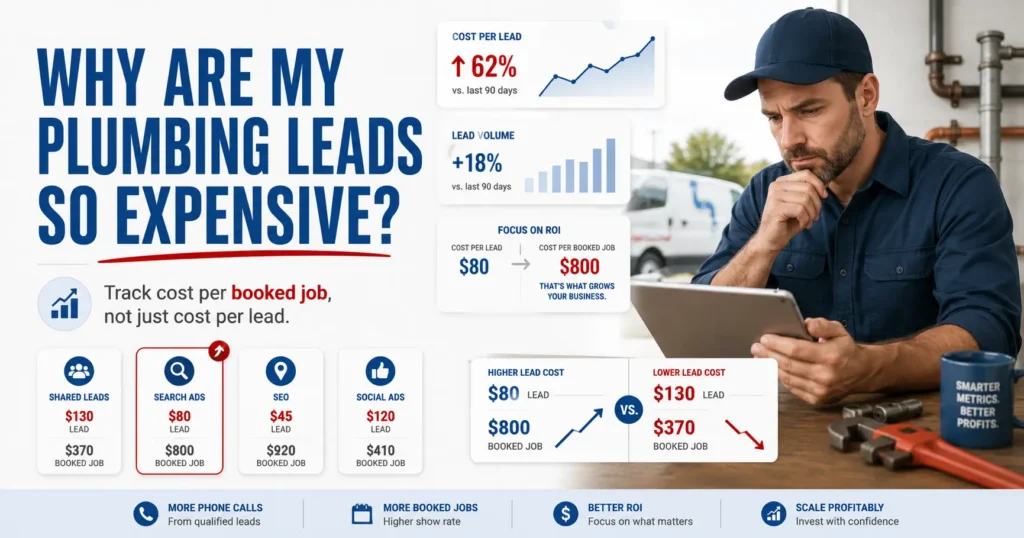
Your agency tells you that leads cost $57, $80, or $130 each. That sounds useful, but it doesn’t tell you what it actually costs to put a job on the truck.
A cheap lead that never books isn’t cheap.
A more expensive lead that turns into a profitable sewer replacement, repipe, or water heater installation can be a great investment.
Here’s a simple comparison:
- A $25 lead closing at 5% costs $500 per booked job
- An $80 lead closing at 10% costs $800 per booked job
- A $130 lead closing at 35% costs about $371 per booked job
- A $150 lead closing at 40% costs $375 per booked job
The $25 lead looks like the winner when you’re staring at an agency report.
It isn’t.
This is why you must track Cost Per Booked Job, also known as Cost Per Acquisition.
The basic formula is:
Cost Per Booked Job = Total Marketing Cost ÷ Number of Booked Jobs
Or, when evaluating lead quality:
Cost Per Booked Job = Cost Per Lead ÷ Booking Rate
That number tells you what it really costs to schedule a job.
And even that’s only part of the story. Eventually, you also need to know which jobs were completed, how much revenue was collected, and how much gross profit they generated.
Why Plumbing Leads Feel Expensive by Channel
Different marketing channels create leads in different ways.
Comparing them only by cost per lead is like comparing a drain-clearing call with a full sewer replacement. They may both be plumbing jobs, but their value to the business is completely different.
1. Angi, HomeAdvisor, and Other Shared-Lead Platforms
These leads often seem affordable at first glance.
You might pay $50, $80, $100, or more for the homeowner’s contact information. The problem is that you may not be the only plumber receiving it.
Contractor lead marketplaces commonly match one homeowner with multiple service providers. That means you’re often competing against several other plumbers who received the same request at roughly the same time.
If a lead is sent to four to six plumbers, the homeowner’s phone can start ringing almost immediately.
Now the job becomes a race.
Who calls first? Who gives the lowest price? Who follows up the most aggressively?
That competition can destroy your close rate.
Consider this example:
$80 lead cost ÷ 10% booking rate = $800 per booked job
Once you calculate the real acquisition cost, that “affordable” lead doesn’t look affordable anymore.
Some plumbing contractors end up paying $500 to $1,000 or more for each job they actually book through shared-lead platforms.
They feel expensive because, in many cases, they are.
2. Google Search Ads and Local Services Ads
Google leads usually have stronger intent because the homeowner is actively searching for a service.
They’re typing things such as:
“Emergency plumber near me.”
“Water heater repair.”
“Sewer line replacement.”
“Plumber open now.”
Google describes Search campaigns as a way to reach people while they’re actively searching for the products or services an advertiser offers.
That intent matters.
You’re not trying to convince someone that they have a plumbing problem. They already know they have one. Your job is to get them to call your company instead of the plumber listed above or below you.
Local Services Ads also appear prominently in eligible searches and charge for valid leads rather than ordinary website clicks. Google states that lead prices can vary by location, job type, lead type, and bidding method.
Google Ads can be very profitable when the account is managed correctly.
But they become expensive fast when the account has:
- Loose keyword targeting that attracts irrelevant searches
- Weak negative-keyword management
- Poor landing pages or confusing offers
- Bad call handling after the lead comes in
- No tracking from the initial click to the completed job
- Bidding algorithms trained on low-quality conversions
A badly managed campaign may technically generate leads while quietly wasting thousands of dollars.
A well-managed campaign focuses on the searches, services, ZIP codes, calls, and job types that actually turn into profitable revenue.
3. Facebook and Instagram Ads
This channel is widely misunderstood.
Some plumbing owners think Facebook doesn’t work at all. Others are told it’s a magical source of unlimited cheap leads.
The truth is in the middle.
Facebook and Instagram work more like television or direct mail than Google Search.
Most people scrolling through Facebook aren’t actively looking for a plumber at that exact moment. Your ad interrupts what they’re doing and puts an offer or problem in front of them.
Maybe it reminds them about the leaking pipe they’ve ignored for two weeks.
Maybe their spouse has been complaining about low water pressure.
Maybe they know their old water heater needs to be replaced, but they haven’t started searching yet.
Meta allows advertisers to reach audiences across Facebook, Instagram, Messenger, and other placements using location and audience targeting.
Response rates can be lower because the intent is different. But the jobs that come through can sometimes be larger, including slab leaks, repipes, sewer work, filtration systems, and water heater replacements.
Facebook should not be judged only by the number of form submissions.
You have to look at:
- How many leads are legitimate homeowners
- How many people answer the phone
- How many appointments are booked
- How many jobs are completed
- The average revenue per completed job
- The total return generated by the campaign
When the tracking is done properly, Facebook can produce a strong return. But it also has volume limits. You can only reach the same local market so many times before performance starts to flatten.
4. SEO and Organic Search
Many plumbing owners assume SEO leads are free.
They aren’t.
You’re still paying for the website, technical maintenance, content, local pages, link building, Google Business Profile work, tracking, and the people managing the strategy.
The difference is that your cost is relatively fixed.
SEO usually takes longer to build. That means the first few leads can look extremely expensive.
Suppose you spend $3,000 a month on SEO and only get five booked jobs during the early months. That’s $600 per booked job.
But if the same investment eventually produces 30 booked jobs, your cost drops to $100 per booked job.
That’s where SEO becomes powerful.
The downside is volume.
Even when your company ranks well organically, ads can appear above the unpaid search results. Google also places Local Services units prominently for eligible searches.
Some homeowners will call an advertiser before they ever reach your organic listing.
SEO can become one of your lowest-cost sources of booked work, but it cannot always produce enough volume by itself to support aggressive growth.
Why Lead Costs Keep Rising
Competition is part of the problem, but it isn’t the whole problem.
Lead costs also rise when your company has weaknesses elsewhere in the customer-acquisition process.
- More plumbing companies are competing for the same high-intent searches
- Slow response times allow competitors to reach homeowners first
- Weak call handling causes good opportunities to be lost
- Poor follow-up lets unbooked estimates and missed calls disappear
- Limited tracking makes bad campaigns look better than they are
- Small service areas restrict how much qualified demand you can capture
- Low review volume can weaken trust and conversion rates
- Marketing budgets are increased before the existing system is fixed
You cannot control every competitor in your city.
But you can control how quickly your phones are answered, how calls are handled, how estimates are followed up, and how accurately every lead is tracked.
Your Close Rate Is the Hidden Lever
One of the fastest ways to lower your cost per booked job is to improve your booking and close rates.
You don’t need cheaper leads to make this happen.
You need to convert more of the opportunities you already paid for.
Let’s say you’re paying $130 per lead.
At a 15% booking rate, your cost per booked job is about $867.
At a 25% booking rate, it drops to $520.
At a 35% booking rate, it falls to about $371.
At a 45% booking rate, it drops again to about $289.
Same channel. Same lead cost. Completely different result.
A good marketing company should do more than send you charts.
They should help you understand what happens after the phone rings.
That includes listening to recorded calls, identifying missed opportunities, finding common homeowner objections, checking response times, and reviewing whether your team is following up.
Google provides tools for tracking phone-call conversions and importing offline outcomes, enabling you to connect advertising activity to deeper sales results rather than stopping at clicks or form submissions.
Sometimes the marketing isn’t the biggest problem.
Sometimes the leads are fine, but nobody answers the phone.
Sometimes the customer service representative immediately asks, “How did you hear about us?” instead of dealing with the homeowner’s emergency.
Sometimes estimates are sent and never followed up.
Sometimes the owner blames Google for calls the office failed to convert.
You can’t fix what you aren’t willing to measure.
The Ultimate Metric Is ROMAS
Cost per booked job is important.
But the bigger number you should watch is ROMAS, or Return on Marketing and Advertising Spend.
ROMAS answers a simple question:
For every $1 you spend on marketing and advertising, how many dollars come back in revenue?
The formula is:
ROMAS = Revenue Attributed to Marketing ÷ Total Marketing and Advertising Cost
The total cost should include the full investment required to produce that revenue.
That may include ad spend, agency management fees, SEO retainers, software, call tracking, creative production, and other direct marketing expenses.
This differs from the standard ROAS number many agencies report, which may compare revenue only to media spend while ignoring the agency fee and other costs.
We want the real number.
Here’s a practical way to evaluate it:
- Below 3X usually requires immediate investigation
- 3X to 5X can be decent during the early months of a campaign
- 6X to 8X is strong for many plumbing companies
- 10X or more is excellent, and we’ve seen months reach roughly 13X
But there’s an important detail.
Revenue is not profit.
If your company has a 20% contribution margin before marketing, then every $5 in revenue yields about $1 to cover marketing costs.
That means you need roughly a 5X ROMAS just to cover a $1 marketing investment.
The exact break-even point depends on your labor, materials, commissions, overhead allocation, average ticket, service mix, and whether you’re measuring booked or collected revenue.
This is why a 3X return might look good on an agency dashboard while still losing money for the plumbing company.
You should track ROMAS both overall and by channel.
Your overall number indicates whether the marketing system as a whole is working.
The channel-level number tells you where to invest more, where to fix problems, and where to stop wasting money.
Build a Plumbing Marketing Scorecard That Tracks Real Jobs
At a minimum, every plumbing company should know these numbers by channel:
- Total marketing and advertising cost
- Number of legitimate leads received
- Number of appointments booked
- Number of jobs completed
- Cost per booked job
- Cost per completed job
- Revenue generated
- Collected revenue
- Average ticket
- Booking and close rates
- Gross profit or contribution margin
- ROMAS
You should be able to compare Google Search, Local Services Ads, SEO, Facebook, referrals, direct mail, and lead marketplaces using the same basic scorecard.
Without that information, you aren’t managing marketing.
You’re guessing.
The Goal Isn't to Find One Magical Lead Source
Every marketing channel has limits.
SEO is powerful, but search volume is finite.
Local Services Ads can produce good opportunities, but availability, competition, ranking, job categories, and lead volume vary by market.
Facebook can create demand, but audiences eventually become saturated.
Google Search can scale further, but additional volume may come at a higher acquisition cost.
The answer isn’t to look for one magical channel that produces unlimited $25 leads.
The smarter approach is to build a balanced system.
- Maximize lower-cost channels such as SEO and Local Services Ads where they perform well
- Use Google Search Ads to capture more high-intent demand
- Use Facebook and Instagram to generate demand for selected higher-value services
- Improve call handling and follow-up before dramatically increasing spending
- Track every lead through the CRM from first contact to collected revenue
- Move budget based on booked jobs, completed work, profit, and ROMAS
Stop Asking What a Lead Costs
Plumbing leads feel expensive because competition is high, every channel has natural limits, and most companies are looking at the wrong numbers.
The cost per lead shown on a report isn’t your real acquisition cost.
What matters is the cost of booking a job, completing the work, collecting revenue, and generating a healthy return.
Track Cost Per Booked Job and ROMAS religiously.
Fix your close rate.
Maximize the channels that produce the best return.
Then use scalable channels to grow beyond their natural limits.
When you build a balanced marketing system and track it all the way to revenue, you stop asking:
“Why are my plumbing leads so expensive?”
And you start asking:
“How much can we profitably invest to grow faster?”