
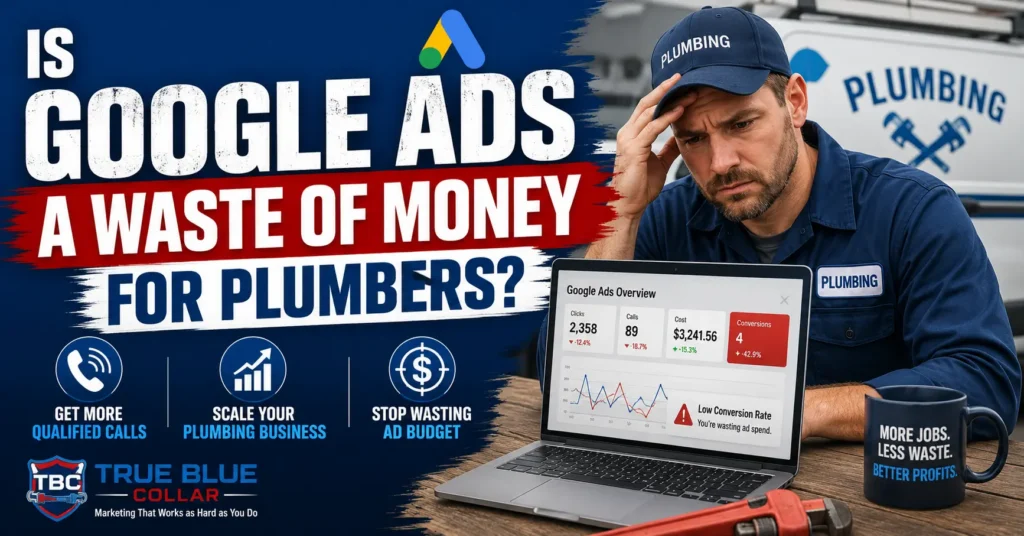
Many plumbers have a bad taste in their mouth when it comes to Google Ads.
They’ve tried it before. They spent thousands of dollars, got some calls, but very few of those calls turned into real jobs.
Then the credit card bill arrived.
They looked at what they spent, looked at the revenue that came back, and thought, “This is a complete waste of money.”
Here’s the honest truth:
Google Ads isn’t a waste of money for plumbers. But it’s extremely easy to waste money on Google Ads.
There’s a big difference.
When it’s set up correctly, Google Ads lets you put your company in front of homeowners who are actively searching for the exact services you provide. You’re not interrupting someone while they scroll through Facebook. You’re reaching someone who may have water pouring through their ceiling, a sewer backing up, or a water heater that just died.
That kind of intent is valuable.
And if you’re serious about scaling your plumbing company to $5 million, $10 million, or even $20 million in annual revenue, Google Ads is one of the few channels capable of delivering consistent, controllable lead volume.
SEO, your Google Business Profile, referrals, Local Services Ads, and Facebook can all produce good work. You should use them. But each channel eventually runs into a volume ceiling.
Google Search Ads give you more control over the services, locations, schedules, search terms, and budgets you want to compete for.
But getting it right is harder than most plumbers, and many plumbing marketing agencies, realize.
Why Most Plumbers Lose Money on Google Ads
The problem usually isn’t Google itself.
The problem is how the campaign was built, what Google was told to optimize for, and what happened after the phone rang.
Common reasons plumbing companies lose money include:
- Using broad match keywords before the account has enough clean conversion data
- Targeting informational searches, DIY questions, jobs, training, parts, and unrelated services
- Sending every visitor to the company homepage
- Using weak or nonexistent negative keyword lists
- Counting every phone call and form submission as a valuable lead
- Running ads when nobody is available to answer the phone
- Making major campaign changes without giving the system time to learn
- Treating Google Ads as a “set it and forget it” service
- Measuring cost per lead without measuring cost per booked job
- Blaming the advertising when the real problem is poor call handling
Negative keywords help prevent ads from appearing for irrelevant searches, while the Search Terms report shows the actual queries that triggered the ads. Both need regular human review. This Isn’t Automatically Bad.
Broad match gets blamed for a lot of wasted plumbing budgets.
Sometimes that blame is justified.
But broad match itself isn’t automatically bad. Google designed broad match to work with Smart Bidding and conversion data. The problem starts when an account uses broad match without enough trustworthy data, without proper negative keywords, or without telling Google which leads actually became booked jobs. bing account with strong offline conversion tracking may use broad match successfully.
A brand-new account that counts every 30-second call as a conversion probably shouldn’t hand Google that much freedom.
The match type has to fit the maturity of the account.
Bad Conversion Tracking Teaches Google the Wrong Lesson
Google’s automated bidding systems use conversion data to decide which searches and users are more likely to produce the outcome you’ve selected.
So what happens if you count a job applicant, vendor call, existing customer, price shopper, wrong number, and five-second hang-up as successful conversions?
You’re teaching the system that those are the results you want.
Google may then optimize toward more interactions that look like them.
The system can’t tell the difference between a profitable sewer replacement and a junk call unless you give it better information.
For a plumbing company, the conversion feedback should eventually include qualified calls, booked appointments, completed jobs, revenue, and ideally gross profit by job type.
Google supports call conversion tracking and offline conversion imports specifically so advertisers can connect ad clicks and calls with what happened later in the sales process. ds Needs Time to Work
Many plumbers expect perfect leads on the first day.
That’s not realistic.
You can start receiving impressions, clicks, calls, and form submissions almost immediately. But a new account still needs time to collect data, identify bad searches, test ads, improve landing pages, and learn which leads turn into revenue.
Google says a Smart Bidding strategy can take up to three weeks, or roughly one to two conversion cycles, to calibrate after a meaningful change. mean the entire plumbing campaign will be fully optimized in three weeks.
In the real world, 60 to 90 days is a reasonable stabilization period for a new account or a major rebuild. During that time, the campaign is collecting enough information to answer questions such as:
- Which services generate qualified calls?
- Which ZIP codes produce profitable jobs?
- Which searches produce price shoppers?
- Which ads attract emergency customers?
- Which landing pages produce booked appointments?
- Which calls turn into completed jobs and revenue?
You should see activity before 60 days. You shouldn’t have to wait three months for the first lead.
But expecting maximum efficiency in the first week usually leads to bad decisions, constant campaign changes, and a system that never gets enough stable data to improve.
This is still very different from SEO, where it may take months before a new page ranks and produces its first meaningful lead. Google Ads gives you immediate traffic and immediate data. You just have to use that data correctly.
The Core Components Most Plumbing Campaigns Get Wrong
Keywords
Your keywords determine which searches you’re entering auctions for.
High-intent plumbing searches may include terms such as:
- Emergency plumber near me
- Sewer line repair
- Water heater installation
- Tankless water heater repair
- Drain cleaning company
- Burst pipe repair
- Gas line plumber
- Sump pump replacement
But the keyword alone isn’t enough.
You also have to understand the service value, urgency, location, competition, and likely customer intent behind the search.
“Water heater” could mean installation, repair, parts, pricing, DIY instructions, or a homeowner trying to decide whether they even need a plumber.
Wrong keywords bring the wrong traffic from the start.
And even a good keyword can waste money if its matching, geographic targeting, negatives, or conversion goal is wrong.
Ad Copy
Your ad should directly match what the homeowner searched for.
If someone searches for sewer line repair, the ad should talk about sewer line repair.
It should not open with a generic statement about how your family-owned company has proudly served the community since 1987.
That information may help later, but it isn’t the immediate reason the homeowner searched.
Start with the problem.
Then give them a reason to choose you.
Useful ad copy may address availability, licensed plumbers, financing, warranties, upfront pricing, same-day service, emergency response, or experience with that specific job.
The promise in the ad also needs to match what the company can actually deliver. Don’t advertise 24-hour emergency service when calls go to voicemail at 8:00 p.m.
Google evaluates how closely the ad matches the intent behind the search, and that relevance is one component of Quality Score. Pages
This is where a huge amount of plumbing advertising money gets lost.
Don’t send every Google Ads visitor to your homepage.
Your homepage has to explain your entire company. It may mention water heaters, drains, sewers, repiping, emergency service, financing, maintenance plans, commercial plumbing, and company history.
That’s too much for someone who searched for one specific problem.
A homeowner who clicked a sewer repair ad should land on a sewer repair page.
That page should immediately confirm:
- You provide the exact service they searched for
- You serve their location
- You can explain the likely next step
- You have proof that your company is credible
- They can call or book without hunting for a button
- The message matches the promise made in the ad
Google recommends choosing landing pages that closely match the ad and keywords because that alignment improves relevance and the landing page experience. a generic homepage might convert at 5% or 6%, while a tightly matched service page can convert at 20% or higher.
In narrow, high-intent situations, such as branded searches or urgent emergency traffic, conversion rates can sometimes reach 30% to 50%.
That isn’t a promise or a universal benchmark. Market conditions, brand strength, traffic quality, pricing, mobile experience, and call availability all matter.
But the point remains:
A better landing page can generate more leads from the same ad spend.
That dramatically changes your real cost per booked job.
Call Handling and Booking
This is the part marketing reports often ignore.
A lead is not a booked job.
A booked job is not a completed job.
And a completed job isn’t necessarily a profitable job.
You can have an excellent Google Ads campaign and still lose money if:
- Calls ring too long
- The phone goes to voicemail
- The person answering sounds rushed or annoyed
- The caller isn’t asked for the appointment
- The dispatcher gives pricing that should be handled by a technician
- Missed calls aren’t returned quickly
- Nobody follows up on unbooked estimates
- The company is already at capacity and can’t schedule the work
Before declaring that Google Ads doesn’t work, listen to the calls.
You may discover that the campaign is producing opportunities, but the company isn’t converting them.
Local Services Ads and Search Ads Are Two Different Games
Local Services Ads and regular Google Search Ads should usually be used together.
But they don’t work the same way.
With LSA, you generally pay for valid leads rather than individual clicks. Your visibility and lead volume are influenced by factors such as bid strategy, budget, reviews, responsiveness, proximity, profile quality, and how likely Google believes your listing is to produce a lead. often less expensive than Search leads, but cheaper doesn’t automatically mean better.
You still need to measure:
- Lead quality
- Answer rate
- Booking rate
- Cost per booked job
- Average ticket
- Revenue and gross profit
LSA also has a natural volume ceiling.
That ceiling isn’t Google deliberately making sure every plumber gets an equal share. It comes from the finite number of local searches, the auction, the number of competitors, your ranking factors, and the available demand in your service area.
Maximize profitable LSA volume first. Then use Search Ads to scale beyond what LSA can deliver.
Search Ads offer more control and more potential volume. A local plumbing company might spend a few thousand dollars per month. A large multi-location operation may spend $50,000 to $100,000 or more per month when the market demand, booked-job economics, staffing, and truck capacity support it.
Spending more isn’t the goal.
Buying profitable jobs at a predictable cost is the goal.
What a Professional Plumbing Google Ads Setup Should Look Like
A professionally managed plumbing campaign should include:
- A Google Ads account owned by the plumbing company from day one
- Separate campaigns or ad groups for major service categories
- Dedicated landing pages for high-value services
- Accurate geographic targeting and service-area exclusions
- Proper call tracking and call recording where permitted and appropriately disclosed
- Call scoring that separates qualified opportunities from junk
- Ongoing Search Terms reviews and negative keyword management
- Ad schedules that match actual call-answering availability
- Accurate feedback on booked jobs, completed jobs, and revenue
- Capacity-aware budget pacing based on technician availability
- Regular landing page and ad testing
- Ongoing optimization as Google changes its platform
- Customer Match and first-party audience lists where the company is eligible and the data was collected appropriately
- Reporting based on booked jobs and revenue rather than impressions and clicks
The plumbing company must own the account.
An agency can be granted manager access, but the agency should not build the account under its own ownership and hold the campaign history hostage if the relationship ends.
The data belongs to the business that paid for it.
Daily Oversight Doesn't Mean Random Daily Changes
Google Ads needs human oversight.
That doesn’t mean someone should panic every morning and start changing bids, keywords, targets, and budgets.
Major or frequent changes can push automated bidding back into a learning period.
Daily oversight means someone is watching for problems such as:
- Sudden junk-call volume
- Broken landing pages
- Tracking failures
- Budget being consumed too early
- Ads running outside service capacity
- Search terms drifting into unrelated intent
- Calls going unanswered
- A valuable service losing impression share
Budget decisions should also connect to operations.
If the schedule is empty and the campaign is producing profitable booked jobs, there may be room to increase spend.
If the company is booked solid for several days, it may make sense to reduce spend, narrow the schedule, or shift budget toward services that can still be handled.
But don’t jerk the campaign around every few hours.
Make deliberate changes based on enough data to justify them.
Stop Measuring Cost Per Lead Alone
Cost per lead matters, but it doesn’t tell you whether the advertising made money.
A $70 call that never books is more expensive than a $200 call that turns into a $6,000 sewer job.
The numbers that actually matter are:
- Cost per qualified lead
- Cost per booked job
- Booking rate
- Close rate
- Average completed-job revenue
- Gross profit generated
- Return on Marketing and Advertising Spend
For example, suppose you spend $20,000 on Google Ads and $3,000 on management and landing pages.
Your total marketing cost is $23,000.
If those campaigns generate $120,000 in attributable revenue, your Return on Marketing and Advertising Spend is approximately 5.2X.
Whether that is profitable depends on your gross margin, technician costs, callbacks, overhead, and the type of work sold.
That’s the conversation your marketing report should create.
Not how many impressions the campaign received.
The Bottom Line
Google Ads isn’t a waste of money for plumbers.
Running it poorly absolutely is.
If you want to scale beyond what referrals, SEO, your Google Business Profile, Facebook, and LSA can deliver, Google Search Ads are one of the most powerful tools available.
But they require the right structure, accurate tracking, strong landing pages, good call handling, ongoing negative keyword management, and someone who pays attention to the actual business results.
Done correctly, Google Ads can become one of your most profitable and controllable growth channels.
Done incorrectly, it becomes an expensive lesson.
The question isn’t whether Google Ads works.
The question is whether you’re willing to run it like a revenue system instead of a click-buying machine.