
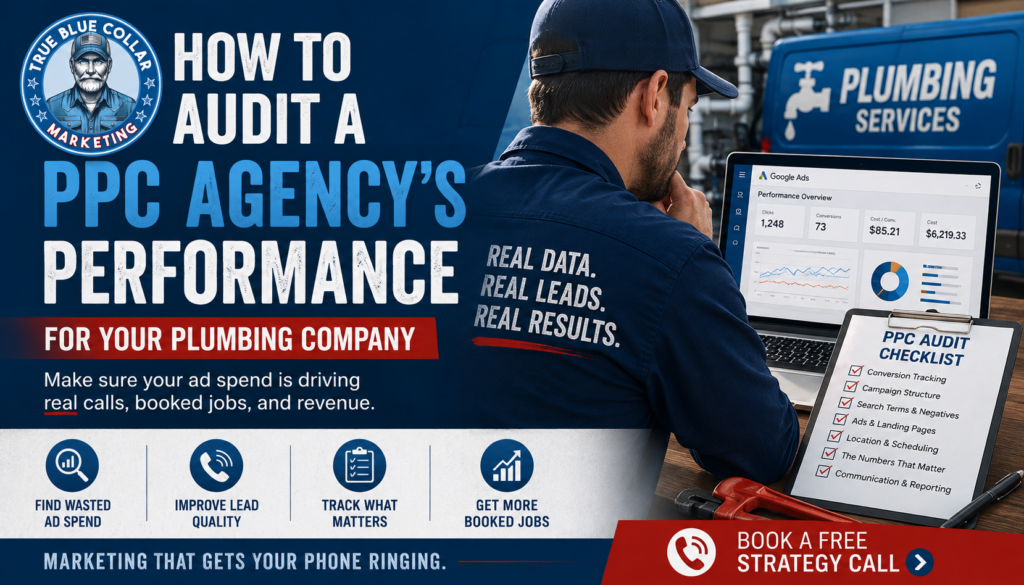
Most plumbing company owners don’t properly audit their Google Ads agency.
And that’s understandable.
You’re running trucks, dealing with technicians, watching payroll, answering customer problems, managing dispatch, and trying to keep the schedule full. You hired a PPC agency because you don’t want to spend your evenings digging through Google Ads.
So every month, a report arrives.
Impressions are up. Clicks look good. There are plenty of “conversions.” Maybe there’s a nice green arrow showing improvement over last month.
But there’s a much more important question:
How many profitable plumbing jobs did all that advertising actually put on your trucks?
If your agency can’t clearly connect your PPC spend to qualified leads, booked jobs, and ultimately revenue, the rest of the report doesn’t mean much.
You don’t need to become a Google Ads expert to hold a PPC agency accountable. But you do need to know where to look and what questions to ask.
Here’s how we’d audit a plumbing PPC account.
1. Start With Something Basic: Who Actually Controls Your Account?
Before looking at cost per click, conversion rates, keywords, or anything else, figure out who controls the assets.
Ask:
- Does your plumbing company have administrative access to the Google Ads account?
- Is the account associated with your business, or does the agency effectively control it?
- Can you access your historical campaign data?
- Do you have access to your call-tracking platform?
- Can you access Google Analytics and related measurement tools?
- Can you access the CRM integrations feeding sales data back into advertising?
An agency may manage your account through its Google Ads manager account. That’s normal.
What isn’t normal is an agency treating your advertising history like its property.
If you change agencies, you shouldn’t have to start from scratch because the previous agency refuses to give you access to years of campaign data.
And access shouldn’t stop with Google Ads.
If your PPC reporting says you generated 83 phone calls last month, you should be able to investigate what happened to those calls. Were they plumbing customers? Existing customers? Vendors? Job seekers? Spam? Did anyone answer?
The first sign of a healthy agency relationship is transparency.
If accessing your own marketing data turns into an argument, you already learned something important.
2. Check Conversion Tracking Before You Trust Anything Else
This is probably the most important part of the entire audit.
Google Ads uses conversion data both for reporting and, depending on the bidding strategy, optimization.
Feed Google bad conversion signals and you can end up teaching the system to find more bad conversions.
For a plumbing company, start by checking whether the agency properly tracks meaningful actions such as:
- Calls generated directly from ads
- Calls generated after someone visits the website
- Qualified form submissions
- Booked jobs or other qualified offline outcomes from your CRM
Google Ads distinguishes between primary and secondary conversion actions. Primary actions can be used for bidding optimization and appear in the Conversions column. Secondary actions can still be measured without necessarily telling the bidding system to optimize toward them.
That distinction matters.
Imagine someone clicks an ad for “emergency plumber near me.”
They visit the website and click the phone number.
If your tracking setup counts the click itself as a valuable lead, but nobody verifies whether a useful phone conversation happened, you can create a very misleading picture of performance.
Google’s own call reporting can track details including call duration and whether a call connected. Advertisers can also define a duration threshold for when a call counts as a conversion.
But even duration doesn’t tell you the whole story.
A three-minute call could be a homeowner with a burst pipe.
It could also be someone asking about a plumbing apprenticeship.
That’s why a serious plumbing PPC operation needs to go deeper than “Google says we got a conversion.”
The better question is: What happened after the lead?
Your agency should have a way to connect advertising with what happens downstream.
That might mean feeding qualified leads, booked appointments, completed jobs, or revenue data from your CRM back into your measurement system.
Google currently supports enhanced conversions for leads, which uses first-party customer information to improve attribution of offline outcomes back to advertising.
In other words, you can give Google a better signal than:
Someone filled out a form.
You can start moving toward:
Someone became a real customer.
That’s a much more useful signal.
And for plumbers, where the difference between a $79 drain inquiry and a multi-thousand-dollar sewer job can be enormous, that distinction matters.
3. Look at How the Campaigns Are Actually Structured
Next, open the campaign list.
Can you tell what’s happening?
You don’t need 47 campaigns with complicated names only the agency understands. But you should see enough organization to understand where the money is going.
Depending on the size of the account, service mix, market, budget, and available conversion data, it can make sense to separate or tightly organize major services such as:
- Emergency plumbing
- Drain cleaning
- Water heaters
- Sewer repair
- General plumbing services
Why?
Because they’re not the same customer.
Someone searching for an emergency plumber at 11:30 p.m. has different intent from someone researching water heater replacement.
The economics can also be very different.
If everything gets dumped into one giant bucket, it becomes harder to answer basic business questions.
Which services are consuming the budget?
Which services produce qualified calls?
Which services produce booked jobs?
Which ones produce enough revenue and margin to justify the acquisition cost?
That’s what campaign structure should help you understand and control.
One important change for plumbing companies in 2026
Historically, an audit could simply tell you to make sure Local Services Ads and traditional Google Search campaigns were clearly separated.
That’s no longer the whole story.
Starting in August 2026, Google is beginning to migrate select U.S. Local Services Ads advertisers, including plumbers, into a specialized Performance Max campaign type inside Google Ads.
These migrated campaigns retain the pay-per-lead model and continue appearing in the same Search and Maps placements associated with Local Services Ads. Google says the migration will expand to additional advertisers later in 2026 and into 2027.
So if you see Performance Max in a plumbing account, don’t automatically assume something is wrong.
Ask what kind of Performance Max campaign it is and why it’s there.
That’s a much better audit question.
A migrated LSA-style Performance Max campaign is very different from an agency deciding on its own to launch a conventional Performance Max campaign.
Your agency should be able to explain the difference clearly.
If the answer is basically, “Google AI handles it,” keep asking questions.
4. Pull the Search Terms Report
This is where things get interesting.
Keywords tell you what you’re targeting.
Search terms tell you what people actually typed before interacting with your ads.
Pull the report for at least the last 30 to 90 days and start reading.
For a plumber, watch for searches around:
- Plumbing jobs and careers
- Plumber salaries
- Apprenticeships and training
- DIY plumbing repairs
- Services your company doesn’t provide
- Searches from areas you don’t serve
- Other irrelevant or low-value intent
You won’t necessarily see every individual query because Google applies privacy thresholds and other reporting limits. But the report still gives you an important window into traffic quality.
Now look at the negative keywords.
A well-managed account should develop a negative keyword strategy over time.
If you’re paying for searches from people looking for plumbing careers, DIY instructions, wholesale parts, or services you don’t offer, that’s money that could have gone toward someone looking for an actual plumber.
This isn’t glamorous work.
There isn’t an exciting AI dashboard for it.
But routinely reviewing what people actually search for is still an important part of managing Search campaigns.
If your agency can’t explain how it reviews search terms and handles irrelevant traffic, ask why.
5. Compare the Search, the Ad, and the Landing Page
Pick several of your highest-value searches and follow the customer’s journey.
Let’s say someone searches:
emergency plumber near me
What does the ad say?
And after clicking it, where do they land?
If the ad talks about emergency plumbing but drops the visitor onto a generic homepage covering drains, water heaters, sewer lines, bathroom remodeling, company history, financing, and 14 other things, you’ve introduced friction.
The visitor told you what they want.
They have a plumbing emergency.
Your advertising should continue that conversation.
The page should make it immediately obvious that they’re in the right place, explain the relevant service, establish trust, and make the next step easy.
Now repeat the process for:
water heater replacement
drain cleaning
sewer line repair
You don’t necessarily need a separate landing page for every keyword variation. That can become ridiculous.
But high-intent, economically important services deserve a customer journey that actually matches the search.
Don’t evaluate ads and landing pages as separate projects.
Evaluate the entire path:
Search → Ad → Page → Call or Form → Booking
Every unnecessary disconnect gives a potential customer another opportunity to leave.
6. Check Location Targeting, Scheduling, and Devices
Plumbing is local.
Which makes wasted geographic traffic especially frustrating.
Google Ads’ default location targeting can include people who are physically in your targeted area or have shown interest in that area.
Google also offers a more restrictive Presence setting for reaching people who are likely to be in or regularly in your targeted locations.
For many local plumbing campaigns, that setting deserves a close look.
But don’t stop at checking a dropdown.
Review where the clicks and conversions are actually coming from.
Google itself notes that location targeting relies on multiple signals and isn’t guaranteed to be 100% accurate. It can also show ads in nearby, closely related areas in some circumstances.
So audit actual geographic performance rather than assuming your settings make leakage impossible.
Then look at scheduling.
If your ads generate a phone call at 10:45 p.m., what happens?
Does someone answer?
Do you have an answering service?
Do you actually provide emergency service?
Or does the call ring into nowhere while you’re still paying to generate it?
Google allows call assets to be scheduled for particular days and hours. Your broader campaign schedule should also reflect how your company actually handles incoming opportunities.
Paying to generate calls nobody can answer is a marketing problem and an operations problem at the same time.
And don’t ignore mobile.
Plumbing customers frequently need an immediate path to call. Audit the mobile experience yourself.
Pull out your phone.
Search.
Click.
Try to call.
Try the form.
See what a customer sees.
You’d be surprised how quickly that exercise exposes problems.
7. Stop Letting Cost Per Lead Be the Final Score
This is where plumbing companies can get fooled by otherwise impressive-looking reports.
Suppose Agency A tells you:
“Great month. We got your cost per lead down to $90.”
Sounds good.
But what happens if only 10% of those leads turn into booked jobs?
Now imagine another campaign generates $140 leads, but 35% become booked jobs.
The cheaper lead isn’t necessarily the better lead.
That’s why your audit needs to move beyond CPL.
At minimum, work toward understanding:
- Cost per qualified lead
- Cost per booked job
- Lead-to-booking or close rate by source
- Revenue attributed to Google Ads
- Revenue attributed to your LSA or migrated pay-per-lead campaigns
- Marketing cost relative to the revenue those campaigns produce
And don’t forget the agency fee.
If you’re trying to understand the economics of your marketing, the management fee is still money you spent to acquire customers.
At TBC, we often look at this broader relationship through ROMAS, Return on Marketing and Advertising Spend.
The basic idea is simple:
How much revenue did the marketing produce compared with what you spent on the advertising and marketing required to produce it?
Even that isn’t the final measure of profitability because plumbing jobs have different gross margins, labor requirements, material costs, callbacks, and overhead.
But it’s much closer to a business metric than impressions.
Ultimately, a plumbing owner should be able to ask:
“What does it cost us to put a real job on a truck?”
And then:
“Are the revenue and margin from those jobs worth what we’re spending to acquire them?”
That’s the conversation your PPC reporting should support.
8. Listen to the Calls
This deserves its own section because spreadsheets can’t tell you everything.
If you’re generating phone leads, someone should be reviewing call quality.
Not necessarily every call forever.
But enough calls to understand what’s happening.
You want to know:
- Are callers looking for services you actually provide?
- Are calls coming from the correct service area?
- Are they new opportunities or existing customers?
- Are job seekers and vendors getting counted as leads?
- Is the office answering?
- Are qualified callers actually getting booked?
- Are leads getting lost because of how the phone is handled?
This is where PPC and operations collide.
An agency might generate an excellent sewer replacement opportunity, but if the person answering the phone sounds annoyed, puts the caller on hold for six minutes, and never asks for the address, the campaign doesn’t get credit for a booked job.
On the other hand, the agency shouldn’t hide behind “your CSR team needs to close better” every time campaign performance struggles.
You need visibility into both sides.
Was it a good opportunity? And what did the company do with it?
That’s how you improve the entire system instead of arguing about whose fault the numbers are.
9. Audit the Agency, Not Just the Google Ads Account
A PPC agency’s job isn’t simply to log into Google Ads and keep campaigns running.
Pay attention to how the agency manages the relationship.
Do they schedule regular performance reviews?
Do they contact you when performance changes significantly?
Can they explain what they’re testing?
Can they explain why they’re making changes?
Do they discuss lead quality?
Do they understand which plumbing services you actually want more of?
Do they ask what’s happening after leads enter your CRM?
If the only communication you receive is an automated report on the first Monday of every month, you’re not getting much strategic partnership.
And if every performance discussion consists of reading metrics already visible on the screen, ask yourself what you’re paying the agency to contribute.
A good PPC partner should help turn advertising data into business decisions.
That requires understanding more than clicks.
The Plumbing PPC Agency Red Flag Checklist
If you’re auditing your current agency, here are some warning signs worth investigating:
You don’t have proper access to the account.
Your business shouldn’t be locked away from its own advertising history.
Conversion tracking doesn’t reflect meaningful customer actions.
Lots of conversions mean very little if Google is optimizing toward junk.
The report celebrates impressions and clicks without connecting them to business outcomes.
Visibility isn’t the same as revenue.
Nobody can connect ad spend to qualified leads, booked jobs, and revenue.
This is one of the biggest problems.
Search terms contain obvious irrelevant traffic month after month.
Some irrelevant searches happen. Repeated patterns that nobody addresses are different.
High-intent traffic gets sent to generic pages with weak message match.
The customer’s search should shape the experience after the click.
Nobody reviews lead quality.
A conversion isn’t automatically a plumbing opportunity.
The agency rarely contacts you unless you contact them first.
That’s account maintenance, not proactive management.
Questions to Ask Your PPC Agency This Month
You don’t have to interrogate your agency with 50 technical questions.
Start with these:
1. Can you show us exactly what Google is optimizing toward as a primary conversion?
2. How many of last month’s reported leads were actually qualified plumbing opportunities?
3. How many became booked jobs?
4. What was our cost per booked job by campaign or source?
5. Can you show us the recent Search Terms report and what negative keywords you’ve added?
6. Which services are producing the best business outcomes, not just the cheapest leads?
7. How are booked jobs or other offline outcomes being fed back into our measurement?
8. What did you change in the account recently, and why?
9. If our LSA account is being migrated into Google’s new Performance Max pay-per-lead setup, what’s changing for us and what historical data do we need to save?
That last question is particularly timely.
Google says that when an LSA account migrates, the old Local Services Ads dashboard will no longer be accessible and previous performance reports won’t carry over into Google Ads.
So if your plumbing company is approaching migration, download and preserve your historical LSA performance data before the transition.
That’s the kind of thing a proactive agency should already be discussing with you.
Your PPC Agency Doesn't Need Perfect Numbers. It Needs Accountability.
No Google Ads account is perfect.
Search behavior changes. Competitors get more aggressive. Cost per click moves. Seasonality hits. Google’s platform changes constantly. Some weeks are simply better than others.
So the goal of an audit isn’t to catch your agency because one metric moved in the wrong direction.
The goal is to answer something much more important:
Does your agency know what’s happening with your money?
They should be able to show you where the budget went.
They should be able to explain what they’re optimizing toward.
They should know whether the leads are any good.
They should understand what happens after those leads reach your company.
And over time, the conversation should increasingly connect advertising activity with booked jobs and revenue.
Because your plumbing company doesn’t make payroll with impressions.
You can’t put clicks on a truck.
And a dashboard full of “conversions” doesn’t help much if nobody knows whether those conversions became customers.
Your advertising has one job: help create profitable business.
Your PPC agency should be able to show you how it’s contributing to that job.
If it can’t, don’t settle for a prettier report.
Ask better questions.
Not Sure What Your Current PPC Agency Is Actually Producing?
True Blue Collar works with home service businesses to build marketing around calls, booked jobs, and measurable business results, not vanity metrics.
Book a Free Strategy Call and let’s look at what your marketing is actually doing for your plumbing company.