
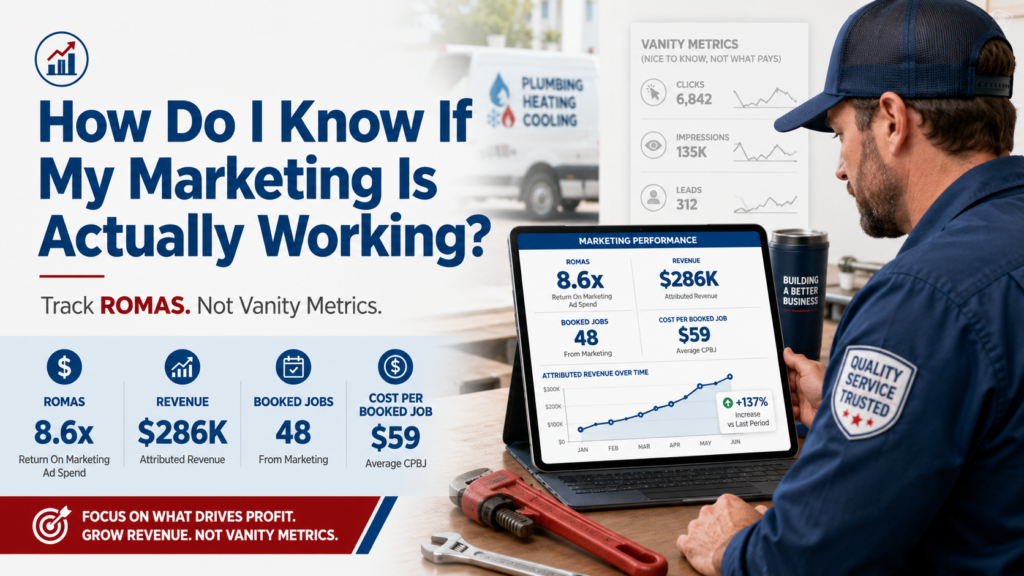
They spend money on marketing every single month — sometimes a lot of it — but they still don’t have a clear answer to one simple question:
Is this actually making me money?
Instead, they get reports full of impressions, clicks, website visits, “leads delivered,” and other numbers that sound good in a meeting but don’t pay the bills.
Here’s the hard truth:
If your marketing company can’t clearly show you that they are making you more money than they cost, your marketing may not be working. You may just be kept in the dark.
Marketing should not feel like a mystery. You should know what you spent, what came in, what turned into booked jobs, and what revenue was created.
If you don’t know that, you don’t really know if your marketing is working.
The One Number That Actually Matters: ROMAS
Forget vanity metrics.
The main number you should look at every month is ROMAS — Return On Marketing And Advertising Spend.
This is not the same as ROAS.
That is not the full picture.
ROMAS is the all-in number.
It includes:
- Google Ads spend
- Facebook Ads spend
- Local Services Ads spend
- Agency management fees
- Call tracking costs
- Landing page or marketing software costs
- Any other marketing-related spend tied to lead generation
Then you compare that total spend against the real revenue those efforts generated.
The formula is simple:
ROMAS = Revenue Generated ÷ Total Marketing and Advertising Spend
For example:
You spend:
- $10,000 on ads
- $4,000 on agency fees
- $500 on call tracking and landing pages
Your total marketing spend is $14,500.
If that marketing produces $72,500 in closed revenue, your ROMAS is:
$72,500 ÷ $14,500 = 5x ROMAS
That means for every dollar you spent on marketing, you generated five dollars in revenue.
That is the number that matters.
Why ROMAS Matters More Than Cost Per Lead
A lot of agencies love talking about cost per lead.
“Your leads only cost $57 each.”
Sounds great.
But one lead is not one job.
Some leads are price shoppers. Some never answer the phone. Some are outside your service area. Some are for work you don’t even do. Some turn into small repairs. Some turn into big-ticket jobs.
That is why cost per lead can be misleading by itself.
What matters more is:
How much did it cost to get a booked job?
And even more important:
How much revenue did those booked jobs produce?
You could have a $50 lead cost and still lose money if none of those leads close.
You could also have a $200 lead cost and make great money if those leads turn into sewer replacements, HVAC installs, repipes, or other high-value jobs.
The lead cost is not the final answer. It is only one piece of the math.
The Break-Even Reality Most Agencies Avoid
Here is where business owners need to be honest with themselves.
If your business runs on a 20% profit margin after labor, materials, overhead, and operating costs, then you need about a 5x return on your all-in marketing spend just to break even.
Why?
Because if you generate $5 in revenue, and your profit margin is 20%, you only keep about $1 in profit before considering other moving parts.
So if you spend $1 on marketing and get $5 back in revenue, you may only be breaking even.
That does not mean 5x is always the goal. For some businesses, 5x may be okay. For others, especially if margins are thin, it may not be enough.
The point is simple:
You cannot judge marketing by leads alone. You have to judge it by revenue, margin, and profit.
That is why ROMAS matters.
Channel Performance Still Matters — But It Is Secondary
You should still look at performance by channel.
A good agency should be able to show you how each source is performing, including:
- Google Ads
- Google Local Services Ads
- Organic SEO
- Google Business Profile
- Facebook Ads
- Retargeting
- Email or reactivation campaigns
- Referral and repeat customer campaigns
This matters because not every channel plays the same role.
You need to know what each channel is doing.
But these are still supporting numbers.
The main number is still your overall ROMAS.
Because at the end of the day, the owner does not care which dashboard looked nice. The owner cares whether marketing helped put profitable work on the board.
Where Most Marketing Tracking Falls Apart
Here is where most agencies fall short.
They track leads, but they do not track what happened after the lead came in.
That is a problem.
Every call and form submission should be tracked, recorded, and reviewed. Not just counted. Reviewed.
There is a big difference between:
“We got you 47 leads this month.”
And:
“You received 47 leads. 31 were qualified. 19 booked. 12 closed into paid jobs. Those jobs produced $84,000 in revenue. Your all-in marketing spend was $14,000, so your ROMAS was 6x.”
That second report actually tells you something.
It tells you whether the marketing worked.
It also shows where the problem is.
If leads are low, the marketing may need work.
If leads are strong but bookings are weak, the issue may be call handling.
If bookings are strong but revenue is low, the campaign may be attracting too many small jobs.
If revenue is strong but profit is weak, pricing or job mix may be the issue.
Without full tracking, everyone is guessing.
Your Agency Should Be Listening to Calls
A good marketing agency should not just count calls.
They should listen to them.
That does not mean listening to every single call forever. But they should review enough calls to understand lead quality, customer intent, missed opportunities, and booking problems.
Call reviews can uncover real issues fast.
For example:
- The ads are bringing in sewer leads, but you don’t do sewer work.
- The campaign is attracting warranty calls that are not profitable.
- Calls are coming in after hours and nobody is answering.
- The office team is quoting prices too early and losing jobs.
- Leads are asking for HVAC installs, but your landing page is pushing repairs.
- The phone is ringing, but calls are being missed during peak hours.
- A dispatcher is not asking for the booking.
- The lead source is sending too many out-of-area calls.
These are not small details. These are the things that make or break marketing ROI.
If your agency never listens to calls, they are missing the real story.
Your CRM Should Be Part of the Picture
This is another big one.
Your marketing company should ask for access to your CRM or reporting system.
That might be ServiceTitan, Housecall Pro, Jobber, FieldEdge, Service Fusion, or another platform.
Why?
Because leads are not enough.
Quotes are not enough.
Booked jobs are not even enough.
The real question is:
Which marketing sources produced actual closed revenue?
A real partner tracks the full path:
Lead → booked appointment → estimate → sold job → completed job → collected revenue
That is how you know what is really working.
If your agency only reports “leads delivered” and never looks at closed jobs, they are not managing marketing like a business investment.
They are just managing activity.
Speed to Lead Can Make or Break the Whole Thing
Marketing can bring the phone to ring.
But your team still has to answer it.
One of the biggest hidden problems in home service marketing is slow follow-up.
If a homeowner fills out a form for emergency plumbing, HVAC repair, or roof damage, they are not waiting around all day. They are calling the next company.
That means speed matters.
You should know:
- How many calls were answered
- How many were missed
- How quickly forms were followed up on
- How many calls went to voicemail
- How many after-hours calls were lost
- Whether your team is calling leads back more than once
Great marketing can still fail if follow-up is weak.
That is why a good agency does not just say, “We sent the leads.”
They help you see where the lead flow is breaking.
Proactive Communication Changes Everything
Your marketing agency should not disappear after sending a monthly report.
That is not enough.
A good agency should stay close to the business.
If it is 11 AM and your call volume is unusually low, they should notice.
If a freeze is coming and burst pipe calls are likely to spike, they should be ready.
If a heat wave is coming, HVAC messaging and budgets may need to shift.
If one campaign suddenly starts bringing bad leads, they should catch it quickly.
If your Local Services Ads are getting charged for junk calls, they should be reviewing and disputing where appropriate.
If your Google Business Profile traffic drops, they should be asking why.
Marketing is not set-it-and-forget-it.
Home service demand changes with weather, seasonality, local competition, staffing, reviews, service area, and urgency.
If your agency is not paying attention to those things, they are not close enough to the business.
Other Metrics Worth Watching
ROMAS is the main number, but it is not the only number worth reviewing.
Here are the supporting metrics that actually matter:
Cost Per Booked Job
Not cost per lead. Cost per booked job.
This tells you what you are really paying to get work on the schedule.
Close Rate by Lead Source
Some lead sources produce better customers than others.
You need to know which sources turn into real jobs and which ones only create noise.
Average Ticket by Source
A source that brings fewer leads may still be more profitable if it brings higher-value jobs.
For example, sewer replacement, HVAC installation, repiping, and roof replacement leads are very different from small repair calls.
Call Answer Rate
If calls are being missed, marketing money is being wasted.
This should be reviewed regularly.
Speed to Lead
How fast does your team respond to forms, missed calls, and messages?
Slow follow-up kills conversion.
Marketing as a Percentage of Revenue
Many healthy home service businesses spend somewhere around 5–10% of revenue on marketing, depending on growth goals, market competition, and business stage.
If you want aggressive growth, that number may be higher.
If you are already booked out and only need maintenance, it may be lower.
The point is not to follow a generic number blindly. The point is to know what you are spending and what it is producing.
Red Flags Your Marketing Is Not Being Managed Properly
Be careful if your marketing company is doing any of these:
- Only showing impressions, clicks, and leads
- Talking about ROAS but ignoring agency fees
- Refusing to show all-in ROMAS
- Not connecting marketing to closed jobs
- Not reviewing call recordings
- Not asking for CRM access
- Not tracking cost per booked job
- Going silent unless you chase them
- Sending generic monthly reports with no real explanation
- Pushing long contracts without proving ROI
- Refusing to give you access to your ad accounts and data
- Blaming your team for everything without showing the numbers
- Taking credit for revenue they cannot actually tie back to marketing
One or two weak spots can be fixed.
But if your agency is avoiding the real numbers, that is a problem.
Questions Every Owner Should Ask Their Marketing Agency
You do not need to be a marketing expert to ask the right questions.
Start with these:
- What was my total all-in marketing spend last month?
- How much closed revenue came from that spend?
- What was my ROMAS?
- What was my cost per booked job?
- Which channels produced the best jobs?
- Which channels produced poor-quality leads?
- How many calls were missed?
- How many leads booked?
- How many booked jobs closed?
- What are we changing next month based on the numbers?
If your agency cannot answer these questions clearly, they are not giving you the full picture.
Bottom Line
You do not need more leads.
You need more profitable jobs at a cost that makes sense for your business.
The only way to know if your marketing is actually working is to measure the right things.
That starts with ROMAS.
Not impressions. Not clicks. Not “leads delivered.”
You need to know what you spent, what revenue came in, what closed, what did not, and what needs to change.
Leads → booked calls → closed jobs → revenue → return on spend
They should communicate proactively, review calls, connect to your CRM, and help you understand what is really happening.
If your current agency cannot clearly show you that they are making you money every month, it is time to ask harder questions.
Because marketing should be one of the highest-ROI investments in your business.
Not a black hole that keeps draining cash.