
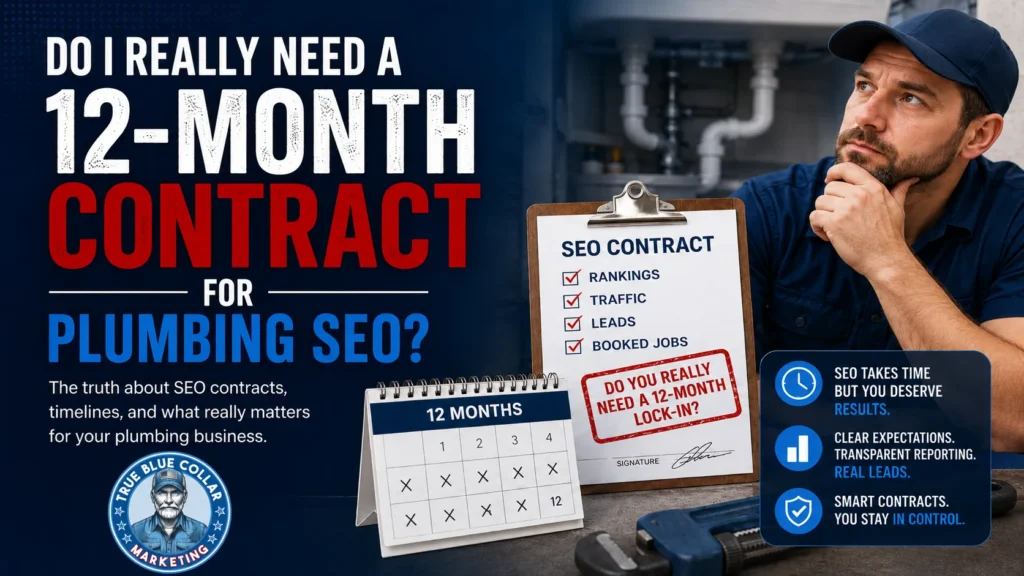
A plumbing company signs a 12-month SEO agreement.
The pitch sounded good. More Google visibility. Better rankings. More calls without paying for every click.
A few months later, the owner starts asking questions.
What exactly has been done?
Why haven’t the important rankings moved?
Are any of these organic visitors actually turning into plumbing calls?
And why does every question seem to get the same answer?
“SEO takes time.”
Yes, SEO takes time.
But that doesn’t automatically mean your plumbing company needs to sign a 12-month contract.
Those are two completely different things.
The better question is this:
Does your SEO company need enough time to produce meaningful progress? Absolutely. Does that require locking your business into an inflexible one-year agreement? No.
Here’s what plumbing business owners should actually look at before signing.
Why Do SEO Agencies Push 12-Month Contracts?
There’s a legitimate reason SEO companies don’t want to be judged after 30 days.
Google itself says some changes to a website can take effect within hours, while others may take several months. Google recommends waiting at least a few weeks before evaluating whether many SEO changes had a beneficial effect.
Local plumbing SEO also involves more than changing a few title tags.
Depending on where you’re starting, the work may include:
- Fixing technical problems that affect crawling or indexing
- Reworking weak plumbing service pages
- Improving internal linking and website structure
- Optimizing your Google Business Profile
- Cleaning up inconsistent business information
- Building useful location and service content
- Improving your review-generation process
- Setting up Search Console, Analytics, call tracking, and conversion measurement
Google says complete and accurate Business Profile information can help a business appear for relevant local searches. It also confirms that reviews and positive ratings can contribute to local visibility.
None of that means rankings suddenly jump next Tuesday.
So yes, an SEO company needs runway.
But here’s where plumbing owners need to separate SEO reality from contract structure.
Google doesn’t require a 12-month SEO contract. There is no magic one-year point where SEO suddenly starts working.
A 12-month agreement is a commercial arrangement between you and your agency.
And while a longer commitment may help an agency plan resources and execute a long-term strategy, it also gives the agency predictable revenue whether you’re thrilled with the work or not.
That’s why the length of the contract should never be the only thing you’re evaluating.
A 12-Month Contract Isn't Automatically Bad
This is where we disagree with some of the advice floating around online.
A 12-month contract by itself is not proof that an SEO company is bad.
Imagine an agency gives you a detailed strategy, clear deliverables, ownership of your assets, transparent reporting, reasonable termination terms, and regular performance reviews.
That’s very different from:
“Sign here for 12 months. SEO takes time. Trust us.”
The problem isn’t necessarily the number 12.
The problem is signing a long commitment when you have no meaningful way to evaluate what you’re getting.
For most plumbing companies, we’d rather see an arrangement where the agency gets enough time to complete the foundational work while the owner still has reasonable protection if nothing meaningful happens.
A sensible structure could include:
- A defined initial commitment or onboarding period
- Clearly documented SEO priorities and deliverables
- Monthly performance reporting
- Scheduled checkpoints to review progress
- Reasonable cancellation terms after the initial period
- Full ownership and access to your marketing assets
Three to six months can be a useful business checkpoint for evaluating whether the strategy is moving in the right direction, but it should not be treated as a guarantee that specific rankings or lead volumes will appear by a certain date.
Google makes that distinction pretty clear. Search performance isn’t fixed, and not every SEO change will produce a noticeable ranking improvement.
What Should You Actually Be Seeing?
This is where plumbing owners should get tougher.
“SEO takes time” should never mean “pay us for six months and don’t ask questions.”
You may not have page-one rankings for every high-value plumbing keyword after 90 days.
Fine.
But something should be happening.
During the early months, you should be able to see completed work such as:
- Technical problems identified and addressed
- Important plumbing service pages improved
- Google Business Profile work completed
- Search Console and conversion tracking properly configured
- Clear baseline rankings and traffic established
- A content and local visibility plan actively being executed
Google recommends verifying Search Console ownership and using its performance reporting to monitor queries, pages, clicks, impressions, and search trends.
That matters because an SEO report shouldn’t require a decoder ring.
If you’re paying to rank for water heater replacement, drain cleaning, sewer repair, repiping, emergency plumbing, or other services that make your company money, you should be able to see whether visibility for those searches is improving.
And rankings alone aren’t enough.
Eventually, that visibility needs to translate into business.
You should be looking at things like:
- Search visibility for commercially important plumbing searches
- Organic traffic reaching your service and location pages
- Calls and form submissions attributed to organic search
- Lead quality, where your tracking setup allows it
- Booked jobs and revenue, when your CRM and attribution systems can connect the dots
An increase in impressions can be encouraging.
But impressions don’t pay your technicians.
The 4 to 6-Month Conversation Matters
Suppose you’ve been working with an SEO agency for several months.
The technical work is supposedly finished.
New pages have gone live.
Your Google Business Profile has been worked on.
Content has been published.
Yet relevant organic visibility hasn’t meaningfully improved, qualified organic leads haven’t moved, and nobody can clearly explain why.
Now you have a reason to push harder.
That doesn’t automatically mean the campaign has failed. Competition, your starting position, previous website problems, market size, Google’s ranking systems, and the quality of the actual work can all affect how quickly results develop.
But your agency should be able to diagnose what is happening.
They should be able to tell you what improved, what didn’t, what they’ve learned, and what they’re changing next.
If the entire strategy after months of work still boils down to “just wait,” that’s not much of a strategy.
Google actually recommends asking prospective SEO providers what results they expect, what timeframe they expect them in, how they measure success, and whether they’ll explain the changes they’re making.
Those are good questions before you sign.
They’re even better questions once you’re paying the invoices.
Red Flags in a Plumbing SEO Contract
Before committing your company, read the actual agreement.
Not just the proposal.
Not just the sales deck.
The contract.
A few things deserve extra attention:
- A hard 12-month or longer commitment with expensive early termination penalties
- No meaningful checkpoints for reviewing performance
- Vague deliverables such as “ongoing SEO optimization”
- No clear explanation of what happens during the first several months
- Reporting built around vanity metrics with no connection to leads
- The agency controlling assets you should control
- Unclear language around who owns content created during the engagement
- Guaranteed #1 Google rankings or similarly absolute promises
That last one is particularly easy.
Google’s own guidance says nobody can guarantee a #1 ranking, and Google specifically warns businesses about SEO providers making those promises.
If somebody tells you otherwise, you don’t need another sales meeting.
You need the exit.
Ownership Matters More Than Most Plumbing Companies Realize
Contract length gets all the attention.
Asset ownership can cause a much bigger headache.
Imagine spending a year building rankings and local visibility only to discover that the agency controls the logins, the website, or the Google Business Profile when you decide to leave.
Now you’ve got a problem.
At a minimum, your plumbing company should maintain control over:
- Your domain registration
- Your website and hosting access
- Your Google Business Profile
- Your Google Search Console property
- Your Google Analytics property
- The content and website assets your agreement says you’re purchasing
Google is especially clear about Business Profile ownership.
Its guidelines say authorized representatives such as SEO agencies should encourage the business owner to own the Business Profile and add the representative as a manager. Google also says authorized representatives must transfer ownership to the business owner when requested and that website content should be owned and managed by the business owner.
A Business Profile can have multiple owners, but only one primary owner. Owners can add and remove users, while managers can handle many day-to-day tasks without controlling ownership.
Search Console works similarly. Verified owners have full control and can grant or remove access for other users.
That’s the setup you want.
Your plumbing company owns the assets. Your marketing company gets the access it needs to do the work.
Not the other way around.
Don't Let a Fancy SEO Report Distract You
SEO reports can get impressive fast.
Charts.
Visibility scores.
Backlink counts.
Hundreds of keywords.
Technical health percentages.
They all have their place.
But don’t confuse activity with business performance.
For a plumbing company, the reporting conversation eventually needs to reach the phone.
Did more homeowners find you organically for services you actually want?
Did they call?
Did they book?
Are the right service pages getting more visibility?
Are you becoming more visible in the parts of town you actually serve?
That is a much more useful conversation than celebrating because some SEO tool moved your “domain authority” score from one number to another.
Google itself recommends Search Console as a first-party source for understanding your site’s Google Search performance, including the queries and pages generating impressions and clicks.
Your agency can absolutely use third-party SEO tools.
Just don’t let the tool become the result.
So, Do You Need a 12-Month Plumbing SEO Contract?
No.
You need a serious SEO strategy with enough time to work.
You need an agency that can explain what it’s doing.
You need tracking that tells you whether visibility is turning into opportunities.
You need regular checkpoints where somebody is accountable for progress.
And you need to own the assets you’re paying to build.
A 12-month agreement can be perfectly reasonable when the scope, expectations, ownership, reporting, and exit terms make sense.
But “SEO takes time” is not a good enough reason by itself to lock your plumbing company into a year-long contract.
Before signing, ask the agency a simple question:
What should I reasonably expect to see along the way, and what happens if we’re not seeing it?
A strong SEO partner should have a clear answer.
If the only answer is another request for patience, read the contract again.
Want to see what a results-focused marketing strategy could look like for your plumbing company? Book a Free Strategy Call with True Blue Collar.