If you’ve been buying leads from Angi, HomeAdvisor, Thumbtack, or similar platforms, you already know the frustration.
You pay good money for the lead.
Then you call.
No answer.
You call again.
Still no answer.
Then, when you finally reach the homeowner, they say they already talked to three other contractors. Or they are “just getting prices.” Or they want the cheapest guy who can show up today.
That is not bad luck.
That is how the model works.
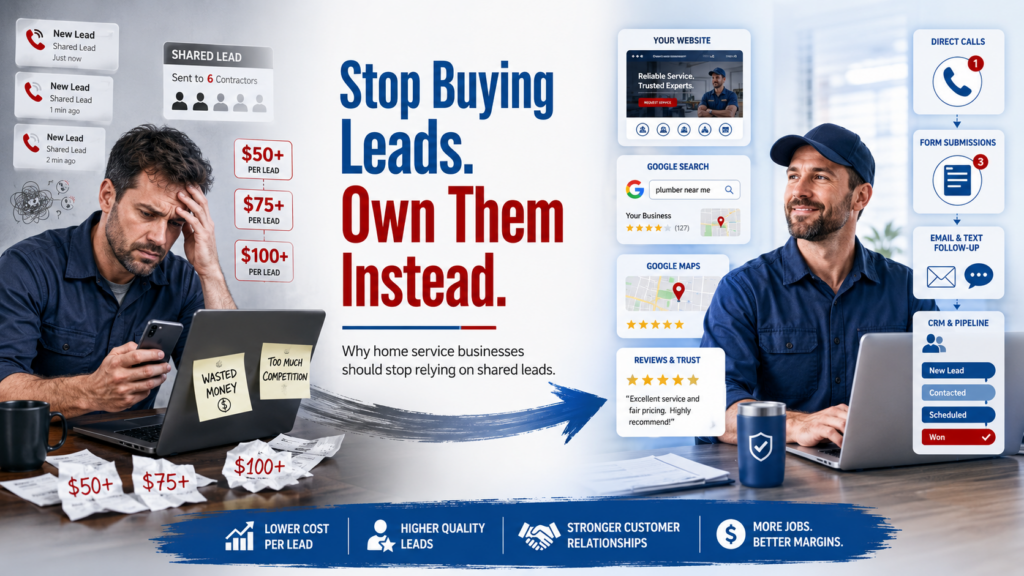
Lead platforms are not built to make your plumbing, HVAC, roofing, or electrical business more valuable. They are built to sell leads. And in many cases, the same homeowner gets pushed to multiple contractors at the same time.
So you are not just paying for a lead.
You are paying to enter a race.
And the race usually comes down to speed, price, and how many other contractors are chasing the same customer.
That is a bad position for a real home service business to be in.
The Real Problem Is Not Lead Cost
Most contractors look at Angi, HomeAdvisor, or Thumbtack and ask one question:
“How much does the lead cost?”
That is the wrong question.
The better question is:
“How much does it cost me to book an actual job?”
Because cost per lead does not pay your bills. Booked jobs do.
That means your real cost per booked job is $750.
And that is before you factor in:
- Time spent chasing bad leads
- Office staff calling people who never answer
- Technicians going out to price-shopper appointments
- Low-margin jobs you only win because you dropped your price
- Lost focus from better marketing channels
This is where contractors get tricked.
They think they are buying affordable leads, but what they are really buying is expensive competition.
If you pay $50 to $100+ per lead and only close 8% to 15% of them, your cost per booked job can easily land in the $400 to $900 range or higher. The math gets ugly fast.
And the worst part?
You are paying that money without building anything you truly own.
Shared Leads Put You in a Weak Position
When a homeowner finds your company directly, the conversation starts differently.
They saw your Google Business Profile.
They clicked your ad.
They read your reviews.
They visited your website.
They called your company.
By the time they talk to you, they know who they contacted.
That creates trust.
With shared lead platforms, the homeowner often has a different experience. They fill out a form, and suddenly their phone starts ringing from multiple contractors. Some homeowners do not even remember which site they used or which company they meant to contact.
Now your team is calling someone who may already be annoyed.
That is not a warm lead.
That is a confused homeowner getting chased by multiple companies.
And when every contractor is fighting for the same job, the customer naturally starts comparing prices. You are no longer selling trust, quality, speed, workmanship, warranty, or professionalism.
You are just one of several numbers on their phone.
That pushes your business toward commodity work.
And commodity work is where margins go to die.
You Do Not Own the Customer
This is the bigger issue most contractors miss.
When you buy a lead from a platform, you may get a phone number and a chance to quote the job. But you are not really building your own customer pipeline.
You are renting access.
That means the platform controls the flow.
They control the rules.
They control the pricing.
They control how much competition is in the system.
And if they raise prices, change the algorithm, reduce lead quality, or send the same lead to more contractors, you have very little control.
That is not a marketing strategy.
That is dependency.
A real business should not depend on renting customers from someone else every month.
Because once you stop paying, the lead flow stops.
Owned Leads Work Differently
When you generate leads through your own marketing, the economics change.
Owned leads come from assets you control:
- Your website
- Your Google Business Profile
- Your Google Ads account
- Your Local Services Ads
- Your SEO
- Your reviews
- Your email list
- Your CRM
- Your past customer database
- Your local brand
These leads are different because the homeowner is contacting your company, not a generic platform.
They see your name.
They see your reviews.
They see your service area.
They see your trucks, your team, your offers, your guarantees, and your reputation.
There is no confusion when your technician shows up.
That matters.
Trust starts before the call. It starts when the homeowner first sees your company and decides you are worth contacting.
You Can Follow Up and Recover Lost Jobs
Here is another major advantage of owning your leads:
You can follow up.
Not every lead books right away. That is normal.
Some homeowners are not ready. Some are comparing options. Some delay the repair. Some try to fix it themselves and fail two weeks later.
If that lead came through your own website, ad, or Google Business Profile, you can follow up with a simple text or email:
“Hey, just checking in. Did you get your plumbing issue taken care of? If not, we’re still happy to help.”
That one message can turn a lost lead into a booked job.
You can also follow up later for:
- Maintenance plans
- Seasonal tune-ups
- Water heater replacement
- Drain cleaning
- HVAC inspections
- Roof inspections
- Electrical safety checks
- Referral requests
- Review requests
This is how one lead becomes more than one transaction.
With bought leads, most contractors treat the lead as dead if it does not book immediately.
With owned leads, you can build a real pipeline.
Your Brand Gets Stronger Over Time
This is the part lead sellers do not talk about.
When you spend money on shared leads, the platform’s brand gets stronger.
When you spend money on your own marketing, your brand gets stronger.
That is a big difference.
Every Google ad impression, every map view, every website visit, every review, every follow-up email, and every repeat customer adds to your local presence.
People start recognizing your name.
They see you more often.
They remember you when something breaks.
They ask for you directly.
That makes it easier to win jobs without always being the cheapest.
This is how marketing becomes an asset instead of just an expense.
You stop renting attention and start building familiarity.
They call the company they already trust.
Bought Leads Can Hide Bad Numbers
One reason contractors stay stuck on lead platforms is because the reporting looks simple.
“You received 40 leads this month.”
That sounds good.
But what happened after that?
How many answered the phone?
How many were real jobs?
How many booked?
How many canceled?
How many invoices were paid?
How much revenue came in?
What was the gross profit?
What was the actual cost per closed job?
This is where most contractors find the truth.
The platform may show lead volume, but lead volume is not the same as profitable growth.
You need to track the whole path:
- Lead source
- Call quality
- Booked appointment
- Show rate
- Estimate given
- Job sold
- Invoice amount
- Gross margin
- Repeat customer value
Without that, you are guessing.
And guessing with marketing money gets expensive.
The Better Way to Transition
This does not mean you have to shut off every lead platform tomorrow.
If Angi, HomeAdvisor, or Thumbtack is filling empty spots on your schedule and the jobs are profitable, keep testing it. But treat it as a backup channel, not the foundation of your business.
The goal is not to be emotional about lead platforms.
The goal is to know your numbers.
Start by tracking your last 90 days.
How much did you spend on each platform?
How many leads came in?
How many booked?
How much revenue came from those jobs?
What was the average ticket?
What was your cost per booked job?
What was your cost per sold job?
What was the real profit after labor, materials, overhead, and marketing?
Once you know that number, compare it to owned channels like Google Ads, SEO, Google Business Profile, email follow-up, and past customer reactivation.
In many cases, contractors find that owned leads close better, create better customers, and build long-term value for the business.
What You Should Build Instead
If you want to stop relying on bought leads, you need a simple owned-lead system.
Not complicated.
Not fancy.
Just solid.
You need a website that clearly explains what you do, where you work, and why homeowners should call you.
You need a Google Business Profile with strong reviews, fresh photos, accurate services, and regular updates.
You need call tracking so you know which leads turn into jobs.
You need a CRM or follow-up system so leads do not disappear after one missed call.
You need review generation so every good job helps bring in the next one.
And you need reporting that shows cost per booked job, cost per sold job, and return on marketing spend.
The Bottom Line
Buying leads from Angi, HomeAdvisor, Thumbtack, or similar platforms can create activity.
But activity is not the same as growth.
If the leads are shared, low-trust, price-sensitive, and hard to close, they may be costing you far more than you think.
The real problem is not that you are buying leads.
The real problem is that you are building someone else’s platform instead of your own pipeline.
When you own your leads, you own the relationship.
You control the follow-up.
You build your brand.
You improve your close rates.
You create repeat customers.
You turn marketing into an asset that gets more valuable over time.
One path keeps you paying over and over for the same kind of lead.
The other helps you build a business people actually remember.
Most contractors who make that switch do not go back.
Want to Know What Your Leads Are Really Costing You?
At True Blue Collar Marketing, we do not stop at cost per lead.
We track what matters: calls, booked jobs, sold jobs, revenue, and actual return on marketing spend.
If you want to see whether your current lead sources are making you money or quietly draining your budget, let’s look at the numbers.
Because once you know your real cost per booked job, the decision gets a lot easier.