
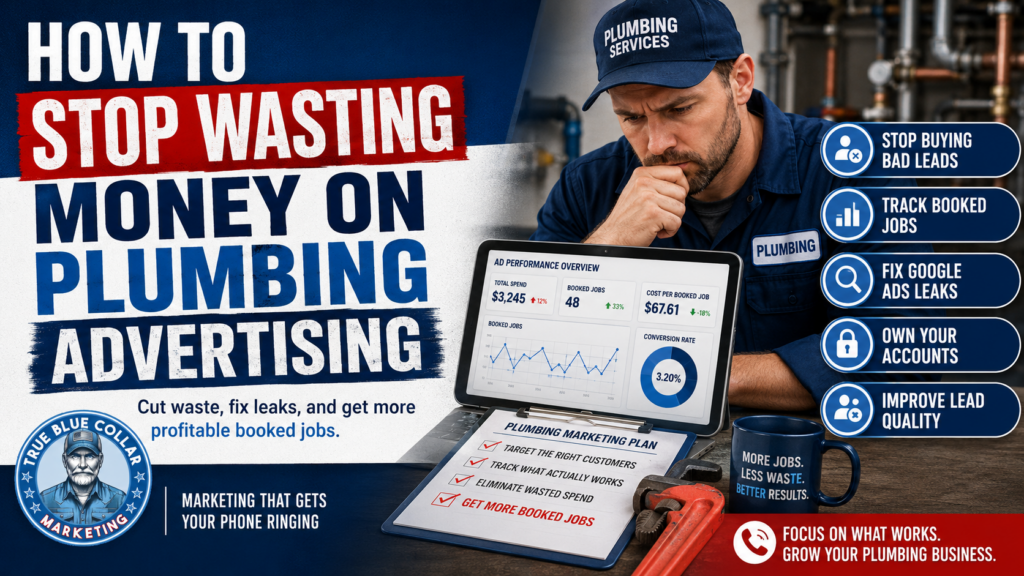
Plumbing advertising rarely wastes your money in one spectacular mistake.
Usually, it leaks out a little at a time.
A few hundred dollars goes toward leads that five other plumbers are chasing. Google Ads spends money on searches you never wanted. Calls come in after hours and go unanswered. Your agency reports 47 “conversions,” but nobody can tell you how many became booked jobs.
Each problem looks manageable by itself.
Put them together month after month, and you’re burning through a serious chunk of your marketing budget without realizing it.
If you’re a plumbing business owner wondering where the money is going, don’t start by asking, “How do we get more leads?”
Start with a better question:
Where are we already wasting money?
Here’s the checklist.
1. Stop Paying for Leads That Don't Make Financial Sense
Lead platforms such as Angi, HomeAdvisor-related services, Thumbtack, and similar marketplaces can put plumbers in front of homeowners looking for help.
That doesn’t automatically make them a bad advertising source.
The problem starts when you’re paying for opportunities where you’re competing heavily for the same homeowner, the lead quality is inconsistent, or the economics simply don’t work.
Don’t judge the platform by how many leads it sends you.
Judge it by what happens after the lead arrives.
Ask:
- How much did we spend on this source?
- How many legitimate plumbing opportunities did it generate?
- How many appointments did we book?
- How many jobs did we actually close?
- How much revenue and gross profit came from those jobs?
The original temptation is to say, “If my close rate is below 15 or 20 percent, kill the source.”
That’s too simplistic.
A lower close rate could still work on high-ticket sewer replacements. A higher close rate could still lose money if you’re paying far too much for low-value drain calls.
The number that matters is your true cost per booked job, followed by the economics of the jobs you close.
Calculate it:
Cost per booked job = Total cost of the lead source ÷ Number of booked jobs from that source
Then compare it with your other channels.
If one source consistently costs far more to generate profitable plumbing work, reduce it or cut it.
Don’t keep buying something because the dashboard says you’re getting “leads.”
2. Demand Real Metrics, Not a Parade of Vanity Numbers
Impressions are useful.
Clicks are useful.
Lead counts are useful.
But none of them answer the question the plumbing owner actually cares about:
Did the marketing produce profitable jobs?
A monthly report can look fantastic while your bank account tells a very different story.
“Your impressions increased 31 percent.”
Great. Did the phone ring?
“We generated 80 conversions.”
Fine. How many were actual homeowners? How many booked? How many turned into jobs?
Your reporting should move beyond the top of the funnel.
At minimum, you should understand:
- Qualified leads by source
- Booked jobs by source
- Cost per booked job by source
- Revenue connected to those jobs
- Total marketing cost, including advertising, management fees, and relevant marketing tools
Google Ads supports sending offline lead outcomes back into the platform, including lead information captured after the original online interaction. Google’s current enhanced conversions for leads system is specifically designed to connect offline lead outcomes with the campaigns that generated them.
That matters.
If your marketing system treats a spam call, a job seeker, a homeowner outside your service area, and a booked $5,000 plumbing job as identical “conversions,” you’re feeding yourself bad information.
And potentially feeding Google bad information too.
3. Fix Tracking Before You Increase the Budget
This is where plumbing companies get themselves into trouble.
Calls are coming in.
Forms are coming in.
The agency says performance looks good.
Then somebody asks:
“Which campaign produced the jobs?”
Silence.
You need to know where your leads actually came from and what happened to them.
That means your tracking system should connect the dots from:
Ad or traffic source → phone call or form → qualified opportunity → booked job → closed job → revenue
Google provides conversion measurement and enhanced conversions for leads specifically to connect advertising activity with later lead outcomes.
For a plumbing company, call tracking matters just as much.
If five campaigns all use the same untracked phone number and nobody knows which source generated the calls, you’re making budget decisions with one eye closed.
And don’t count everything as a valuable conversion.
A 12-second wrong-number call isn’t the same as a homeowner booking a water heater replacement.
A job applicant isn’t a plumbing lead.
An out-of-area caller isn’t valuable just because Google counted the phone interaction.
Before you pour more money into advertising, make sure you trust the data you’re using to make the decision.
Increasing spend on broken tracking doesn’t solve the problem.
It just helps you make expensive mistakes faster.
4. Own Your Accounts and Your Data
Here’s a question every plumbing owner should be able to answer immediately:
If you fired your marketing agency tomorrow, what would you lose?
You should have appropriate administrative access to the marketing assets your business depends on, including your Google Ads account, Google Analytics property, call-tracking system, website-related assets, and other critical marketing data.
Google Ads allows businesses to grant and remove user access, and Google explains that a client account retains its data even when a manager account has ownership privileges. Google also notes an important wrinkle: if an agency’s manager account creates a new Google Ads account, that manager becomes the owner by default.
That’s exactly why you should understand the setup before there is ever a disagreement.
Check:
- Do you have administrator access?
- Who created the account?
- Who currently controls account ownership?
- Can you remove or change agency access if necessary?
- Can another agency take over without rebuilding everything from scratch?
Google Analytics has its own account and property access controls as well.
Your agency should manage your marketing.
It shouldn’t hold your marketing history hostage.
5. Find the Biggest Google Ads Leaks
Google Ads can put a plumbing company in front of someone searching for help right now.
It can also spend money very efficiently on things you never intended to pay for if the campaigns, conversion data, and controls aren’t managed properly.
Start with the search terms.
Google’s Search Terms report shows the queries that triggered your ads, and Google specifically recommends using it to identify irrelevant searches and negative keyword opportunities.
For a plumber, that means looking for searches that indicate the wrong intent.
You may find searches around:
- Plumbing jobs and salaries
- DIY plumbing instructions
- Plumbing classes or certification
- Parts and supplies
- Services you don’t offer
- Cities outside your service territory
- Questions that have little or no commercial intent
Don’t assume broad match itself is the enemy.
That’s outdated advice.
Google currently recommends broad match alongside conversion-based Smart Bidding, and broad match now uses multiple signals beyond the literal keyword when determining relevant searches.
But that does not mean you turn broad match loose and stop paying attention.
If your conversion tracking tells Google that every weak phone call is a success, Smart Bidding has weak information to optimize around.
So review search terms regularly.
Build and maintain negative keywords. Google provides both campaign-level and account-level negative keyword controls for filtering searches you don’t want.
Then look at where the click lands.
If somebody searches for “sewer line repair near me,” dumping that person onto a generic homepage and making them hunt for sewer information creates unnecessary friction.
For major services, build pages around the service the customer searched for. Make the next step obvious.
And look at your hours.
If you’re paying for calls at 2:00 a.m. but nobody answers and you don’t have an effective after-hours process, examine whether that spend makes sense.
Google Ads allows campaigns to run only during specified days and hours, so you can align scheduling with how your business actually handles leads.
The answer won’t always be “turn nights off.”
Emergency plumbing can be valuable after hours.
The answer is to compare the cost, booking rate, job value, and staffing reality by time of day.
6. Watch the Contract, Not Just the Campaigns
A weak advertising relationship becomes much more expensive when you’re trapped in it.
Before signing with a marketing agency, understand:
- Initial commitment
- Cancellation terms
- Notice requirements
- Early termination fees
- Ownership of accounts and creative assets
A six-month or twelve-month agreement isn’t automatically bad.
And month-to-month isn’t automatically good.
The real question is what happens if the agency stops performing.
Can you make a reasonable change?
Or are the contract terms designed to make leaving painfully expensive?
Marketing takes time to test, optimize, and improve. An agency needs enough runway to do real work.
But there’s a difference between giving a strategy time to work and being trapped in an arrangement that isn’t producing results.
Results and a productive working relationship should be the main reasons you stay.
7. Don't Blame Marketing for a Sales Problem
Sometimes the advertising is doing its job.
The plumbing company isn’t.
A homeowner calls.
Nobody answers.
They call another plumber.
A web lead comes in.
Someone follows up four hours later.
The homeowner already booked somebody else.
Or the CSR answers with:
“Yeah, we’re pretty busy. Maybe we can get somebody out Thursday.”
And the owner wonders why the marketing leads “don’t convert.”
Look at what happens after a lead enters the business.
How quickly do you answer?
How quickly do you respond to missed calls?
How does your team handle price shoppers?
Do CSRs actually ask for the appointment?
Do you track booking rates by marketing source?
Do you listen to calls when a campaign appears to be underperforming?
One source may genuinely deliver weaker leads.
But if every lead source has a booking problem, you’ve probably got an operational problem too.
Don’t double your advertising budget to compensate for a broken front desk.
Fix the marketing and the booking process together.
8. Stop Depending on One Expensive Source
If almost every new customer comes from one paid platform, you don’t really control your lead flow.
The platform does.
Google Ads can change.
Lead costs can climb.
Competition can get more aggressive.
A lead marketplace can change how it distributes opportunities.
That’s why a plumbing company’s long-term marketing system shouldn’t depend on a single faucet being turned on forever.
Paid search can generate immediate high-intent demand.
But you should also keep building channels and assets that strengthen your position over time.
That can include:
- Search engine optimization
- Your Google Business Profile
- Your website and service-area pages
- Past-customer email and follow-up
- Maintenance and service reminders
- Referral activity
- Reputation and review generation
The goal isn’t to abandon paid advertising.
It’s to stop building a business where turning off one advertising account makes the phones go silent.
TBC’s broader philosophy for home-service businesses is built around owning the marketing system and reducing dependence on rented lead sources.
9. Calculate the Return That Actually Matters
At the end of the month, put the marketing report aside for a minute.
Open the numbers.
What did you actually spend?
Include the real costs:
Advertising spend + agency fees + relevant marketing tools = total marketing cost
Then determine how much attributable revenue came from that marketing.
A simple revenue-to-marketing-spend calculation is:
Revenue attributed to marketing ÷ Total marketing cost
But don’t stop there.
Revenue isn’t profit.
If one campaign produces a pile of low-margin jobs while another produces fewer but more profitable sewer, repipe, or water heater jobs, lead count alone can point you in the wrong direction.
Compare marketing performance with the economics of the work you want.
Ask:
After labor, materials, overhead, marketing cost, and the rest of the job economics, is this channel helping us make money?
That’s the standard.
Not clicks.
Not impressions.
Not a screenshot showing a green percentage increase.
Profitable work.
Your Monthly Plumbing Advertising Review
Once a month, sit down with whoever controls your marketing and answer these questions:
- What was our cost per booked job for each major source?
- Which sources produced the most valuable closed jobs?
- What was our overall return on marketing spend?
- Where did the weakest or least relevant leads come from?
- What search terms or traffic did we stop paying for?
- Where are leads falling out between first contact and booking?
- What did we actually change in the campaigns this month?
- Are results improving, declining, or simply moving around?
That meeting shouldn’t turn into a 45-minute presentation about impressions.
You should leave knowing what worked, what wasted money, and what you’re changing next.
The Bottom Line
Most plumbing advertising waste isn’t mysterious.
It usually comes from paying for the wrong opportunities, tracking the wrong outcomes, optimizing toward weak conversion data, leaving irrelevant traffic unchecked, giving up control of critical accounts, or failing to connect leads with what actually happened in the business.
And sometimes the ads aren’t the biggest problem at all.
Sometimes you’re already paying for good opportunities and losing them when the phone rings.
So don’t automatically respond to a slow month by buying more traffic.
Start by plugging the leaks.
Know your cost per booked job.
Know which jobs came from which source.
Know what happened to the calls.
Know who controls the accounts.
Know whether those jobs produced enough value to justify what you spent.
You don’t need a report full of more leads. You need a marketing system that produces more profitable plumbing work with less wasted spend.
If you’re spending money on plumbing marketing but can’t clearly see which channels are producing booked jobs, Book a Free Strategy Call with True Blue Collar.
We’ll help you look at where the money is going and where the leaks may be hiding.