You’re spending money on Google Ads. Maybe you’re running Local Services Ads, working on SEO, posting on social media, or paying an agency every month.
But the phone still isn’t ringing consistently.
One week the board looks great. The next week your CSRs are staring at quiet phones and you’re wondering whether you need to cut the marketing budget, switch agencies, or throw more money at Google.
Sound familiar?
Here’s the problem: HVAC marketing rarely fails because of one big mistake.
Usually, several smaller problems are stacking on top of each other.
Your advertising might be generating calls, but nobody knows which calls turned into booked jobs. Your ads might be doing their job, but calls are getting missed. Your Google Ads campaign might be optimized around every phone call instead of the calls that actually make you money.
Or maybe your entire marketing strategy wakes up when the temperature hits 95 degrees and goes back to sleep in October.
Fixing HVAC marketing starts with figuring out where the system is breaking.
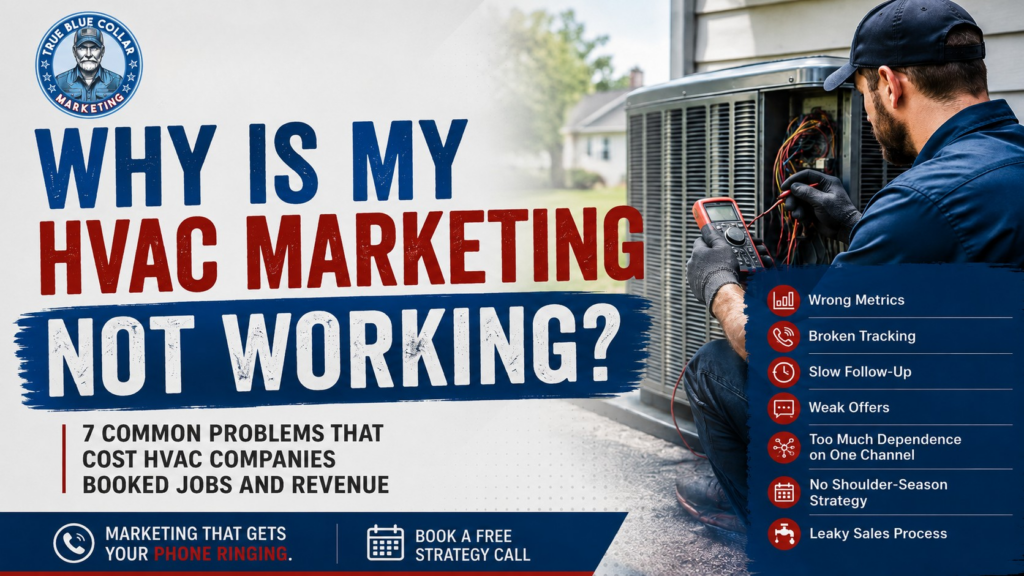
Here are seven places to look.
1. You're Only Marketing During Peak HVAC Season
This is one of the easiest traps for an HVAC company to fall into.
It gets hot. Phones start ringing. Search volume goes up.
So you turn up Google Ads.
Then the weather gets comfortable, call volume drops, and the natural reaction is to slash the marketing budget.
The problem is that plenty of your competitors are reacting to the same weather.
During periods of heavy HVAC demand, more contractors may compete aggressively for customers who need immediate service. That can make Google’s ad auction tougher and lead acquisition more expensive, although the actual costs vary dramatically by market, competition, service type, and campaign.
Then the weather changes and everyone complains that “the leads disappeared.”
That’s not much of a marketing strategy. It’s weather chasing.
A stronger HVAC marketing system keeps working throughout the year, but the message changes with the season.
During extreme heat, that may mean AC repair and emergency service.
When temperatures moderate, the focus can move toward:
- Maintenance plans
- AC or furnace tune-ups
- Planned system replacement
- Heating or cooling inspections
- Efficiency upgrades
- Older-system replacement conversations
There’s a real service reason behind that messaging. ENERGY STAR recommends regular HVAC maintenance and notes that yearly tune-ups can improve system efficiency and comfort.
That creates an opportunity for HVAC companies to market something other than “your system broke, call us.”
The goal isn’t to spend exactly the same amount every month.
The goal is to stop turning marketing completely on and off based on the thermometer.
2. You're Measuring Leads Instead of Business
Ask an HVAC owner how marketing performed last month and you’ll often hear something like:
“We got 84 leads.”
Okay.
What happened to them?
How many booked?
How many actually ran?
How many turned into revenue?
And how much did you spend to generate that revenue?
This is where a lot of marketing reports fall apart.
Clicks matter for diagnosing advertising campaigns. Calls and forms matter because they show response. But they’re not the final scorecard.
The numbers an HVAC owner should care about include:
- Cost per booked job
- Close rate by marketing source
- Revenue generated compared with total marketing spend, including management costs
- Average ticket from marketing-generated jobs
You can go deeper as your tracking improves, but start there.
Because a $40 “lead” isn’t cheap if most of those leads never book.
And a $150 lead isn’t necessarily expensive if it consistently turns into profitable installation work.
That’s why judging marketing purely by cost per lead can send you in the wrong direction.
Google itself provides advertisers with conversion values so businesses can measure more than the raw number of conversions and distinguish higher-value outcomes.
Your marketing dashboard should answer a business question, not just an advertising question:
What did we spend, what did we book, and what did that business produce?
If nobody can answer that clearly, you don’t really know whether the marketing is working.
3. Your Tracking and Attribution Are Broken
HVAC is still heavily dependent on phone calls.
That creates a basic problem.
Someone searches Google for “AC repair near me,” clicks your ad, visits your site, calls the tracking number, speaks with your CSR, books an appointment, gets a technician dispatched, and eventually spends money with your company.
Which part of your reporting knows that happened?
In a lot of HVAC businesses, the answer is: not enough of it.
Google Ads can track phone calls from ads and websites, and Google also supports importing qualified and converted offline leads back into the advertising system.
That matters.
Because there’s a huge difference between teaching Google:
“This person called us.”
and teaching the system:
“This lead became a qualified opportunity or closed customer.”
Google specifically recommends sending offline values from qualified or closed leads when businesses measure those outcomes in their CRM.
Common HVAC tracking problems include:
- No reliable call tracking
- Treating every phone call as a legitimate lead
- Counting short, irrelevant, or non-sales calls as conversions
- No offline conversion data feeding back into Google Ads
- No clear connection between marketing sources and the CRM or dispatch system
- Forms being tracked without knowing whether they booked
- Agencies reporting conversions without separating qualified opportunities from noise
Even Google distinguishes between calls and call conversions. Advertisers can define call conversion criteria rather than assuming every call represents the same value.
Your marketing platform knows how somebody found you.
Your CRM knows what happened after they contacted you.
Those two sides need to talk to each other.
Otherwise you’re trying to optimize advertising with half the story.
4. Your Sales Process Is Leaking Leads You Already Paid For
Sometimes the advertising isn’t the problem at all.
The lead came in.
Then nobody answered.
Or the homeowner reached voicemail.
Or somebody called back much later.
Or the CSR picked up but didn’t confidently move the conversation toward an appointment.
The marketing gets blamed anyway.
That’s an expensive mistake.
Think about an AC outage in August.
The homeowner isn’t casually researching a new coffee table. They want their house cool again.
They may contact more than one HVAC company. If your competitor answers professionally, communicates availability clearly, and gets an appointment booked while your caller is still sitting in voicemail, you may lose a lead you already paid to generate.
That means your marketing system doesn’t stop when the phone rings.
Look at what happens next:
- What percentage of calls are answered live?
- What happens to missed calls?
- How quickly does someone follow up?
- Does the CSR know how to handle pricing questions without killing the call?
- Are after-hours leads handled differently?
- Can someone actually book the job while the customer is on the phone?
- Are calls reviewed so you know why good opportunities aren’t booking?
You can have a well-built Google Ads campaign and still get terrible economics if the intake process leaks opportunities.
Before you increase the advertising budget, make sure the business can properly handle the leads you already have.
5. Your Offer and Message Sound Like Every Other HVAC Company
Take a look at a typical HVAC website.
You’ll see some version of:
“Quality service at a fair price.”
“Your trusted comfort experts.”
“Family-owned since 1998.”
“Customer satisfaction is our priority.”
None of those statements are necessarily bad.
They’re just not giving the homeowner much help choosing between you and the five other HVAC companies saying almost exactly the same thing.
A stronger campaign answers a more practical question:
Why should this homeowner call you right now?
Maybe you offer same-day service.
Maybe there’s a specific guarantee.
Maybe you offer financing.
Maybe your maintenance plan includes benefits worth explaining.
Maybe your company specializes in a particular type of system or problem.
Use those things if they’re actually true.
Don’t manufacture an offer because some marketing guru said every ad needs one.
Then make the landing page match the search.
Someone searching for emergency AC repair shouldn’t have to dig through a generic homepage that also talks about furnaces, duct cleaning, commercial HVAC, indoor air quality, maintenance plans, company history, careers, and twelve other things.
Give that person a page about AC repair.
Someone researching HVAC replacement should see replacement information.
Someone interested in a tune-up should land on a page built around tune-ups.
Different intent. Different conversation.
Your advertising gets more useful when the message before the click matches the message after the click.
6. You're Too Dependent on Shared Leads or One Marketing Channel
Shared-lead platforms can look attractive because they appear to solve the lead problem quickly.
Buy leads. Call homeowners. Book jobs.
But when the same opportunity goes to multiple contractors, you don’t own that customer acquisition process. You may be racing other companies to reach the same homeowner, and the real cost of acquiring a booked job can look very different from the advertised cost of the lead.
That doesn’t mean every third-party lead is worthless.
It means you need to understand what you’re actually buying and measure the economics at the booked-job level.
The other mistake is putting nearly everything into one channel.
For many HVAC businesses, that one channel is Google Ads.
Search advertising can be extremely important because it reaches homeowners actively looking for service. Local Services Ads can also generate direct calls and messages for eligible HVAC businesses.
But you don’t want the entire health of your pipeline depending on one advertising platform, one campaign, or one weather event.
A healthier marketing mix can include high-intent demand capture through Google Search and Local Services Ads while also building assets through:
- SEO
- Google Business Profile
- Customer reviews
- Website content
- Customer retention
- Maintenance-plan marketing
- Email and CRM follow-up
- Reactivation of previous customers
The point isn’t to be everywhere.
The point is to avoid renting your entire pipeline.
The more customer data, reviews, organic visibility, website traffic, remarketing audiences, and existing customer relationships your business builds, the more control you have over what happens next.
7. You Don't Have a Real Shoulder-Season Strategy
This might be the biggest missed opportunity in HVAC marketing.
Emergency HVAC demand is reactive.
The unit quits. The homeowner searches. Somebody gets the call.
You don’t control when the compressor fails.
But not every HVAC job needs to start with a breakdown.
Maintenance is predictable.
Older equipment can be identified before it dies.
Replacement conversations can happen before the first 100-degree day.
Efficiency concerns can be addressed while the homeowner still has time to think.
ENERGY STAR, for example, recommends considering replacement when an air conditioner or heat pump is more than 10 years old, along with other performance and comfort indicators.
That means the shoulder season doesn’t have to become “wait for the weather to change” season.
Use it.
Reach previous customers whose equipment is due for service.
Promote tune-ups.
Build maintenance-plan membership.
Follow up on replacement estimates that didn’t close.
Build campaigns around aging systems and efficiency improvements.
Talk to homeowners before they’re standing in a 90-degree living room desperate for somebody, anybody, to show up.
That kind of marketing gives you a chance to create demand instead of only fighting over emergency demand.
What Actually Moves the Needle in HVAC Marketing?
If your marketing feels broken, don’t immediately change agencies, double the Google budget, or add another lead provider.
Start by fixing the fundamentals.
1. Track every serious lead through revenue
Know where the call or form came from, whether it booked, what type of job it became, and what revenue it produced.
2. Measure cost per booked job
Cost per lead is useful, but it doesn’t tell you whether your technicians actually got work.
3. Market year-round
Change the campaign and offer with demand instead of disappearing whenever temperatures become comfortable.
4. Fix speed-to-lead and booking
Audit missed calls, after-hours handling, callbacks, CSR conversations, and booking rates.
5. Use dedicated landing pages and clearer offers
Match AC repair ads to AC repair pages. Match replacement campaigns to replacement pages. Make the next action obvious.
6. Separate emergency, maintenance, and replacement marketing
These customers have different needs, different urgency, and potentially very different economics. Stop treating every HVAC lead as the same thing.
7. Own your leads and your data
Build systems where your business controls the website, tracking, customer information, CRM history, and marketing data instead of depending entirely on rented leads.
The Real Question Isn't "Is Marketing Working?"
Here’s the better question:
Is your marketing consistently producing profitable booked jobs at a cost your business can support?
Because marketing activity is easy to produce.
Clicks are activity.
Impressions are activity.
Phone calls are activity.
A dashboard full of green arrows is activity.
What pays for trucks, technicians, dispatchers, inventory, and growth is booked and completed work.
If you’re spending money every month but still dealing with unpredictable call volume, expensive customer acquisition, poor attribution, and empty trucks when the weather gets mild, don’t assume marketing itself doesn’t work.
Look at the whole system.
The campaign.
The tracking.
The phone call.
The booking process.
The follow-up.
The customer data.
The shoulder-season plan.
That’s where HVAC marketing usually gets won or lost.
Want to find out where your HVAC marketing system is leaking opportunities? Book a Free Strategy Call with True Blue Collar.